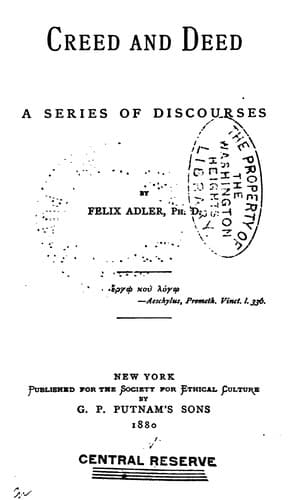
Creed and Deed: A Series of DiscoursesAdler, Felix
Religion
Creed and Deed: A Series of Discourses
Adler, Felix
Ethical culture movement; Ethics; Religion
Thirdly: Large portions of the Pentateuch were probably not composed
before the sixth or fifth century B. C, that is to say about a thousand
years after the time of Moses. The account they give of the early
history of the people is therefore open to serious and just doubt. The
prophets were the real authors of monotheism. The priestly code of the
Pentateuch does not represent the form of Judaism which they taught.
They are not chargeable with the technicalities and dry formalism of the
"Books of Moses." They were the avowed enemies of the priesthood and for
a long time engaged in fierce struggles with the ruling hierarchy. Their
doctrines were in the essence these: That there is a Creator, that he
is just and merciful, that the same qualities in man are the most
acceptable species of divine service, that God directs all events,
whether great or small; and that it is the duty of man to accept the
guidance of the Deity, and to follow with tireless diligence the clews
of the Divine Will. Jehovah is to be reverenced not only as a spiritual,
but also as a temporal sovereign, and the prophets are his ministers
commissioned to transmit his decrees to men. Thus Monotheism found
expression in the form of Theocratic government. It is true the heathen
world was not yet prepared to enter into so near a relationship with the
Creator. On this account the Jews were selected to be a typical people,
and the Kingdom of God was for the time being confined to them. It
is evident from the above that the order of the prophets was the very
mainstay of the Theocratic fabric. When these inspired messengers
ceased to appear, the conclusion was drawn that the Will of God had been
fully revealed. The writings of the prophets were then collected into
sacred books, and were regarded as the constitution of the divine
empire. When Jerusalem was destroyed, the sacrifices were discontinued
and Judaism was purged of many heathenish elements which had been
allowed to mar the simplicity of the prophetic religion. The synagogue
took the place of the Temple, and an intricate code of ceremonies was
gradually elaborated, intended to remind the pious Jew at all hours and
seasons of his duties toward God, and the peculiar mission accorded to
his people. The synagogue was a single prominent peak in the range
of the religious life, a rallying point for the members of the Jewish
community, a meeting house where they assembled to confirm their
allegiance to their heavenly King.
Public-domain text, read in full here on John Shaqi.
Reviews
Reviews
No reviews yet
Be the first to share your thoughts on this work.
Elsewhere in the archive
Join the Discussion
Join the discussion
Sign in to leave a comment or review.
Sign InorCreate an account