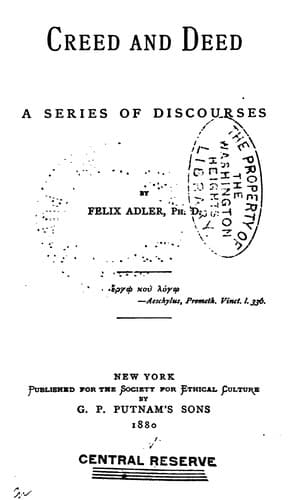
Creed and Deed: A Series of DiscoursesAdler, Felix
Religion
Creed and Deed: A Series of Discourses
Adler, Felix
Ethical culture movement; Ethics; Religion
On the banks of the Euphrates there flourished of old an extensive
colony of Jews. A "Prince of the Captivity" revived the memory of the
vanished glory of King David's house. High schools were erected that
afforded a common centre to the scattered members of the Jewish Faith.
In these the people beheld at once their bond of connection with the
past, and the pledge of future restoration to their patrimony. In the
early part of the middle ages, a prayer for the health and prosperity of
the presidents of the high schools was inserted into the liturgy. Well
nigh eight hundred years have elapsed since these dignitaries, and
the schools themselves, have ceased to exist, yet the prayer is still
retained, and may be heard repeated on any Sabbath in the synagogues of
the orthodox--a prayer for the health of the Prince and the high schools
on the Euphrates that vanished from the face of the earth eight hundred
years ago. Thus do religious forms continue to maintain themselves long
after their vitality is perished and their very meaning is forgotten.
But if the prevalent forms have ceased to satisfy us, can we therefore
dispense with form altogether? If the house that has given us shelter is
in ruins, shall we therefore live in the woods and fields, or shall we
not rather erect a new mansion on a broader foundation, and with firmer
walls? It has been the bane of liberalism, that it was simply critical
and not constructive. Your thought must have not wings only, but hands
and feet to walk and work, to form and reform. Liberalism must have its
organs, must enter the race with its rivals; must not criticise only,
but do better. Liberalism must pass the stage of individualism, must
become the soul of great combinations. What then shall be the form
adequate to express the new Ideal?
The form of any religion is the image of its ideal. To illustrate what
this means, let us consider for a moment the origin of the synagogue and
the church.
The orthodox opinion that Judaism was revealed to Moses fourteen hundred
years B. C. is condemned by modern critics of the Bible. The following
are some of the considerations that have influenced their verdict.
First, we read in scripture that so late as the reign of David, idolatry
was still rampant among the Hebrews, and the attempt to explain this
fact upon the theory of a relapse, is contrary to the testimony of the
Bible itself.
Secondly: The name of Moses is unknown to the prophets, his ostensible
successors, a circumstance which would remain inexplicable if Moses had
indeed been the founder of monotheism.
Public-domain text, read in full here on John Shaqi.
Reviews
Reviews
No reviews yet
Be the first to share your thoughts on this work.
Elsewhere in the archive
Join the Discussion
Join the discussion
Sign in to leave a comment or review.
Sign InorCreate an account