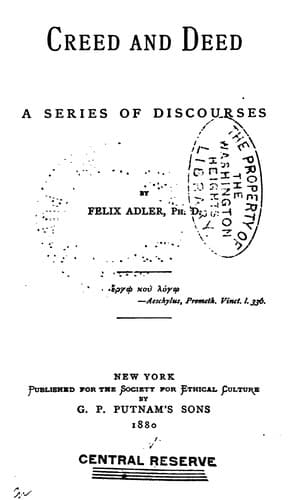
Creed and Deed: A Series of DiscoursesAdler, Felix
Religion
Creed and Deed: A Series of Discourses
Adler, Felix
Ethical culture movement; Ethics; Religion
In the cities an attempt to supply the deficiency was made by the party
of the Pharisees. They sought to broaden and to spiritualize the meaning
of scripture--they laid down new forms of religious observance by means
of which every educated man became, so to speak, his own priest. The
religion of the Pharisees however assumed a not inconsiderable degree of
intellectual ability on the part of its followers. So far as it went it
answered very well for the intelligent middle classes. But out in the
country districts it did not answer at all; not for the herdsmen, not
for the poor peasants, not for those who had not even the rudiments of
learning and who could do nothing with a learned religion. And yet these
very men before all others needed something to support them, something
to cling to, even because they were so miserably poor and illiterate.
They did not get what they wanted--they felt very strongly that the
burdens upon them were exceedingly grievous; that while they suffered
and starved, religion dwelt in palaces, and had no heart for their
misfortunes. They felt that something was wrong and rotten in the then
state of affairs, and that a new state must come, and a heaven-sent
king, who would lend a voice to their needs, and lift them with strong
arms from out their despair and degradation. Nowhere was this feeling
more marked than in the district of Galilee. A beautiful land with
green, grassy valleys, groves of sycamores, broad blue lakes, and
villages nestling picturesquely on the mountain slopes, it nourished
an ardent and impulsive population. Their impatience with the existing
order of things had already found vent in furious revolt. Judah, their
famous leader, had perished; his two sons, James and Simon, had been
nailed to the cross; the Messiah was daily and hourly expected; various
impostors successively arose and quickly disappeared; when would the
hour of deliverance come; when would the true Messiah appear at last?
It was at such a time and among such a people, that there arose Jesus
of Nazareth in Galilee. What was the startling truth he taught? What was
the new revelation he preached to the sons of men? An old truth, and an
old sermon--Righteousness; no more, meaning nothing at all, a mere trite
common-place, on the lips of the time-server and the plausible vendor of
moral phrases. Meaning mighty changes for the better, when invoked with
a profounder sense of its sanctity, and a new sacredness in life, and
larger impulses for ever and for ever. Righteousness he taught, and
the change that was to come by righteousness. Yes, so deep was his
conviction, so profoundly had the current conceptions of the day
affected him, that he believed the change to be near at hand, that he
himself might be its author, himself Messiah.
Public-domain text, read in full here on John Shaqi.
Reviews
Reviews
No reviews yet
Be the first to share your thoughts on this work.
Elsewhere in the archive
Join the Discussion
Join the discussion
Sign in to leave a comment or review.
Sign InorCreate an account