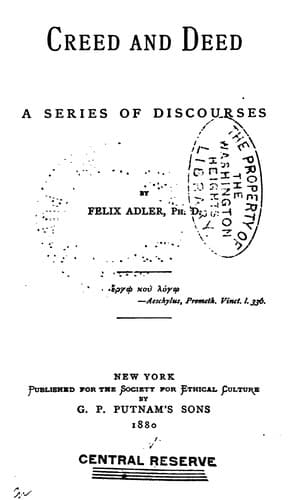
Creed and Deed: A Series of DiscoursesAdler, Felix
Religion
Creed and Deed: A Series of Discourses
Adler, Felix
Ethical culture movement; Ethics; Religion
But we shall not touch the true secret of his power until we recall
his sympathy with the neglected classes of society; that quality of his
nature which caused the poor of Galilee to hail him as their deliverer,
which produced so lasting an impression upon his contemporaries, and
made the development of his doctrines into a great religion possible.
His gospel was preeminently the gospel for the poor: he sat down with
despised publicans, he did not shun the contamination of lepers, nay nor
of the moral leprosy of sin--he visited the hovels of paupers and
taught his disciples to prefer them to the mansions of the fortunate; he
applied himself with peculiar fervor to those dumb illiterate masses of
Galilee, who knew not whither they might turn, to what they might cling.
He gave them hope, he brought them help. And so it came about that in
the early Christian communities which were still fresh from the presence
of the master, the appeal to conscience he had made so powerfully,
resulted in solid helpfulness; so it came about that in those pristine
days, the Church was a real instrument of practical good, with few
forms, and little parade, but with love feasts and the communion table
spread with repasts for the needy. "Come unto me all ye that labor and
are heavy laden and I will give you rest. Take my yoke upon you and
learn of me, * * * for my yoke is easy and my burden is light." It is
from such particulars that there was drawn that fascinating image which
has captivated the fancy and attracted the worship of mankind. The
image of the pale man with the deep, earnest eyes, who roused men to new
exertions for the good, who lifted up the down-trodden, who loved little
children and taught the older children in riddles and parables that they
might understand, and the brief career of whose life was hallowed all
the more in memory, because of the mournful tragedy in which it closed.
All the noblest qualities of humanity were put into this picture and
made it lovely. It was the humanity, not the dogma of Jesus, by which
Christianity triumphed. Like a refreshing shower in the perfumed spring,
his glad tidings of a new enthusiasm for the good came upon the
arid Roman world, sickening with the dry rot of self-indulgence, and
thirsting for some principle to give a purpose to the empty weariness
of existence. Like a message from a sphere of light it spread to the
Germanic tribes, tempered the harshness of their manners, taught them
a higher law than that of force, and conquered their grim strength with
the mild pleadings of the Master of meekness in far-off Galilee.
Public-domain text, read in full here on John Shaqi.
Reviews
Reviews
No reviews yet
Be the first to share your thoughts on this work.
Elsewhere in the archive
Join the Discussion
Join the discussion
Sign in to leave a comment or review.
Sign InorCreate an account