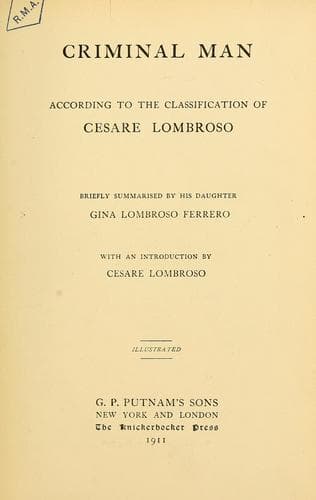
Criminal Man, According to the Classification of Cesare LombrosoLombroso, Gina
Science
Criminal Man, According to the Classification of Cesare Lombroso
Lombroso, Gina
Criminal anthropology; Criminology
England was the first country to provide asylums for the criminal
insane. In 1840 a portion of Bedlam was set aside for this purpose.
Fisherton House, a special private asylum of this kind, was opened in
1844, and later others were instituted at Dundrum (Ireland) in 1850, at
Broadmoor in 1863, and at Perth (Scotland) in 1858, to receive criminals
who commit crimes in a state of insanity, or become insane during their
trial, and all prisoners whose state of lunacy or imbecility renders
them unable to conform to the discipline of a prison. Of course
sanguinary and violent scenes often occur in these asylums, where the
pernicious influence this type of lunatic exercises over his
surroundings in ordinary asylums or prisons is multiplied and
intensified a hundred-fold. Conspiracies, almost unknown in common
asylums, and the murder of warders or officials are very common.
Despairing of release and conscious of their irresponsibility, these
wretched beings attack the warders, destroy the walls which confine
them, murder and wound others and themselves; but at any rate the injury
is limited to a small circle, and both harmless lunatics and common
criminals are not contaminated. Moreover, even in criminal asylums, long
experience with these strange pathological types and the adoption of
subdivisions like those recently introduced into Broadmoor by Orange
have done much towards improving the general condition and eliminating
many drawbacks. According to this classification insane criminals are
divided into two classes, _unconvicted_ and _convicted_, the former
class being subdivided into _untried_ and _tried_. Untried offenders,
those who are considered to have been insane before committing the
crime, are sent to a common county asylum, where are also confined
persons convicted of minor offences and declared insane (the percentage
of cures in this class is considerable) and others suspected of shamming
insanity. In this way, the better elements are eliminated and the
inmates of the criminal insane asylum reduced to the worst and most
dangerous types only.
CAPITAL PUNISHMENT
When, notwithstanding prisons, deportation, and criminal asylums,
individuals of ineradicable anti-social instincts make repeated attempts
on the lives of others, whether honest men or their own companions in
evil-doing, the only remedy is the application of the extreme
penalty--death.
Amongst barbarous peoples, on whom prison makes but slight impression,
or in primitive communities that do not possess criminal asylums,
penitentiaries, and other means of social defence and redemption, the
death penalty has always been considered the most certain and at the
same time the most economical means of common protection. But criminal
anthropologists realise that the desire to abolish this penalty, which
so often finds expression in civilised countries, arises from a noble
sentiment and one they have no wish to destroy.
Public-domain text, read in full here on John Shaqi.
Reviews
Reviews
No reviews yet
Be the first to share your thoughts on this work.
Elsewhere in the archive
Join the Discussion
Join the discussion
Sign in to leave a comment or review.
Sign InorCreate an account