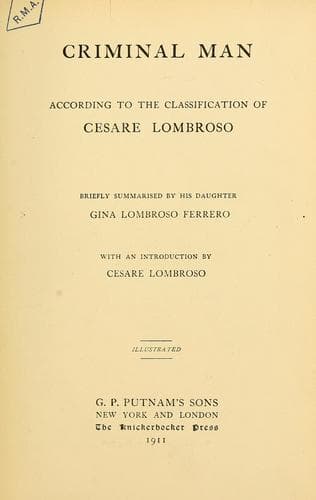
Criminal Man, According to the Classification of Cesare LombrosoLombroso, Gina
Science
Criminal Man, According to the Classification of Cesare Lombroso
Lombroso, Gina
Criminal anthropology; Criminology
The examination of a criminal or person of criminal tendencies should,
if possible, be preceded by a careful investigation of his antecedents.
Questions put to relatives and friends often bring to light facts
relating to his past life, and give an idea of the surroundings in which
he has grown up and the illnesses suffered by him during childhood
(meningitis, typhus, convulsions, hemicrania, giddiness, _pavor
nocturnus_, trauma). The prevalence of disease in the family (parents,
grandparents, uncles, cousins, etc.) should be elicited and note taken
not only of nervous maladies, but of arthritic, tuberculous, pellagrous,
and inebriate forms, including a tendency to morphiomania. Even goitre
should not escape notice, since it may indicate cretinism or any other
form of degeneration. The existence of criminality in the family is of
still greater importance, but it is extremely difficult to obtain any
information on this head, either from the patient himself or his
relatives. A certain amount of strategy must be used in eliciting facts
of this kind, by suddenly asking, for instance, whether a certain
individual of the same name, already deceased or confined in
such-and-such an asylum or prison, is any relation of the patient.
Next should be ascertained whether he is single or married, and in the
latter case, whether his wife is still living; also what profession or
professions he has exercised. In this connection it should be observed
that although criminals are generally successful in everything they
undertake, they are incapable of remaining constant to one thing for any
length of time.
Many persons, cooks, tavern-keepers, confectioners, etc., exercise
callings that have a deleterious effect on the nervous centres and
encourage an abuse of alcohol; others like bakers, have night work,
which is equally harmful. Professions which bring poor men, servants,
secretaries, cashiers, etc., into close contact with wealth, are
sometimes the cause of dishonesty in those who in the absence of special
temptations, would have remained upright; others provide criminaloids
with opportunities or instruments for accomplishing some crime, as in
the case of locksmiths, blacksmiths, soldiers, doctors, lawyers, etc.
The time of the year and other circumstances under which the crime takes
place should be elicited, and it should be borne in mind that the
vintage season in countries of Southern Europe and extremes of heat and
cold are favourable to seizures of an epileptic nature.
When the subject under examination is a recidivist, care should be taken
to ascertain at what age and under what circumstances the initial
offence was committed. Precocity in crime is a characteristic of born
criminals, and puberty and senility have their peculiar offences, as
have the extremes of poverty and wealth.
Public-domain text, read in full here on John Shaqi.
Reviews
Reviews
No reviews yet
Be the first to share your thoughts on this work.
Elsewhere in the archive
Join the Discussion
Join the discussion
Sign in to leave a comment or review.
Sign InorCreate an account