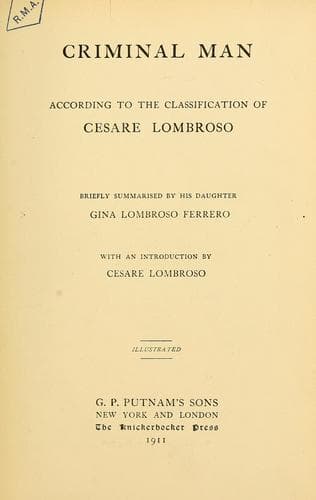
Criminal Man, According to the Classification of Cesare LombrosoLombroso, Gina
Science
Criminal Man, According to the Classification of Cesare Lombroso
Lombroso, Gina
Criminal anthropology; Criminology
The dilatation and contraction of the pupil in accommodation to the
distance of the object viewed or in response to light stimuli is
undoubtedly the most important cutaneous reflex movement. It may be
tested by requesting the patient to look at a distant object and
immediately afterwards at the examiner's finger, placed close to his
eye, or bringing him suddenly from semi-darkness into the light. If the
pupil reacts very slightly to the light, it is called torpid: if it does
not react at all, it is called rigid. Rigidity of the pupil always
denotes some serious nervous disturbance. In certain diseases,
especially tabes, the pupils do not respond to light stimuli, but
accommodate themselves to objects.
_Tendinous Reflex Action_ may be tested in every part of the body, but
the rotular reflex movement is generally sufficient. The patient is
asked to sit on the edge of the bed or on a chair with his legs crossed.
If he is healthy, the reflex movement is fairly strong, but in some
illnesses spastic movements may be provoked and extend to the abdomen
(exaggerated reflex action); in others no reflex is forthcoming. This is
one of the first symptoms of tabes.
=FIG. 39
HEAD OF AN ITALIAN CRIMINAL=
_Urine_ and _Feces_. As the functions are anomalous, the chemical
changes must also be anomalous, owing to the correlation of organs. In
born criminals there is a diminished excretion of nitrogen, whereas that
of chlorides is normal. The elimination of phosphoric acid is increased,
especially when compared with the nitrogen excreted. Pepton is sometimes
found in the excretions of paralytic persons in whom there is always an
increased elimination of phosphates and calcium carbonate.
The temperature is generally higher than in normal persons, and, more
important still, varies less in febrile illnesses.
* * * * *
For the reader's convenience, I have drawn up a list of the different
points that should be noted in a careful examination.
_Table showing the Anthropological Examination of Insane and Criminal
Patients_ (_drawn up by Tamburini, Strassmann, Benelli, and Mario
Carrara_).
A--_Anamnesis._ Name--surname--nationality--domicile--profession--
age--education.
Economic and hygienic conditions of native place.
Family circumstances--pre-natal conditions--infancy--puberty.
Causes to which decease of parents may be attributed.
Cases of insanity--neurosis--imbecility--perversity--suicide--crime--or
eccentricity in the family.
Progressive diseases or trauma in the subject.
Offence and causes thereof.
B--_Physique._ Skeletal development--height--span of the arms.
Public-domain text, read in full here on John Shaqi.
Reviews
Reviews
No reviews yet
Be the first to share your thoughts on this work.
Elsewhere in the archive
Join the Discussion
Join the discussion
Sign in to leave a comment or review.
Sign InorCreate an account