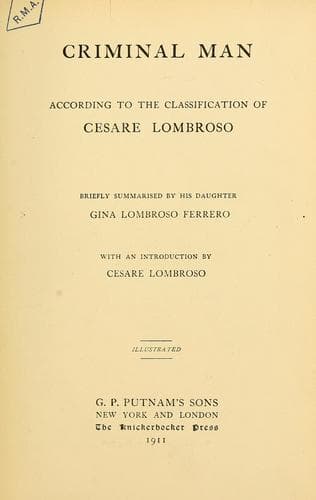
Criminal Man, According to the Classification of Cesare LombrosoLombroso, Gina
Science
Criminal Man, According to the Classification of Cesare Lombroso
Lombroso, Gina
Criminal anthropology; Criminology
When dealing with a simulation of epilepsy, it must be borne in mind
that the epileptic always manifests salient degenerate characteristics,
especially asymmetry of the face, skull, and thorax; and a careful
investigation reveals neurosis of some kind in the family and trauma or
serious illness in childhood. During the seizure, the pupil does not
react (this cannot be simulated) or there is excessive mydriasis. The
sudden pallor, and the exhaustion which follows the fit, are absent in
the simulator, nor does he bite his tongue or injure himself in other
ways. Furthermore, he reacts at the application of ammonia, and as he is
not in that state of asphyxia in which the epileptic lies during the
fit, the closing of his mouth and nostrils likewise produces a reaction.
_Hysteria._ Here the detection of shamming is more difficult, since
deceit is a characteristic of this disease. Tests with metals, to which
hysterical persons are extremely sensitive, suggestion and hypnotism
should be resorted to. The character of the crime should be specially
considered, because, as we stated, the foundation of hysteria is an
erotic one, and offences committed by the hysterical are nearly always
of this nature in the means or the end.
An examination of sensibility with suitable instruments, and of reflex
action, is to be recommended in all cases.
PRACTICAL APPLICATION OF CRIMINAL ANTHROPOLOGY
The minute study of the criminal admits of infinite applications. It is
generally used in deciding to which category of crime a particular
offender belongs, whether he is a born criminal, a morally insane
subject, an occasional criminal, or a criminaloid; but in certain cases
the examination may be of value in establishing the innocence of an
accused person, or in recognising in an accuser an insane individual
whose accusation originates in some delusion and not in a knowledge of
the facts.
AN ACCUSED MAN PROVED INNOCENT BY THE ANTHROPOLOGICAL EXAMINATION
On the 12th of January, 1902, a little girl of six, living at Turin,
suddenly disappeared. Two months later, the corpse was discovered hidden
in a case in a cellar of the very house the little victim had
inhabited. It bore traces of criminal violence and the clothing was in
disorder. Various persons were arrested, among them a coachman named
Tosetti, who had been seen joking and playing with the child on several
occasions.
Public-domain text, read in full here on John Shaqi.
Reviews
Reviews
No reviews yet
Be the first to share your thoughts on this work.
Elsewhere in the archive
Join the Discussion
Join the discussion
Sign in to leave a comment or review.
Sign InorCreate an account