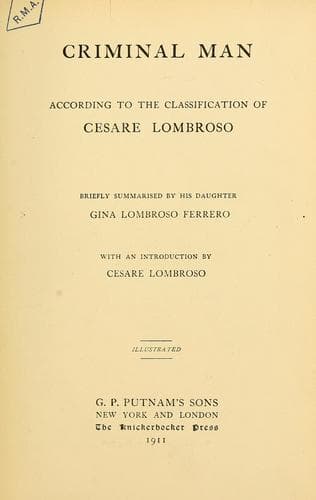
Criminal Man, According to the Classification of Cesare LombrosoLombroso, Gina
Science
Criminal Man, According to the Classification of Cesare Lombroso
Lombroso, Gina
Criminal anthropology; Criminology
He showed a profound and unshaken belief in his own assertions, such as
is rare in simulators or in sufferers from melancholia, but is peculiar
to monomaniacs, especially if subject to delusions and convinced that
they are the object of general persecution.
Careful investigation of the crime showed that it was entirely without
motives and had been committed openly without any attempt to escape or
to establish an alibi. It bore no resemblance to ordinary crimes and was
clearly a case of monomania with hallucinations. This diagnosis was
confirmed by the fact of the anomalies in the field of vision and
sensibility, the acoustic hallucinations, and, psychologically, the
anomalous nature of the affections and moral sense.
It was impossible to suppose that any of these peculiarities had been
simulated, because the subject was far too ignorant to be aware of the
importance of hallucinations and alterations in the senses and
affections. Moreover, his whole bearing was that of a man profoundly
convinced that he had done his duty, and he had no motive for shamming
to escape punishment, since it evidently never entered his head that he
ran any risk of incurring it. He was sent to an asylum.
APPENDIX
WORKS OF CESARE LOMBROSO (BRIEFLY SUMMARISED)
I
_The Man of Genius (L'Uomo di Genio)_
In 1863, my father was appointed to deliver a series of lectures on
psychiatry to the University of Pavia. His introductory lecture, "Genius
and Insanity," showed the close relationship existing between genius and
insanity; and the theme proved so absorbingly interesting to him that he
threw himself into the study of the problem with all the ardour of which
he was capable.
Those who have never come into contact with mentally deranged persons
may deem it absurd to mention genius and insanity in the same breath,
and still more absurd to seek to demonstrate the existence of flashes of
inspiration in insane persons. In the minds of most people, the word
_lunatic_ has from earliest childhood conjured up the vision of an
incoherent, stupid, or demented being, with wildly streaming hair,
raging in paroxysms of maniacal fury, or sunk in imbecile apathy; not,
certainly, a sharp-witted individual capable of reasoning logically. But
the briefest of visits to an ordinary asylum will make it plain to any
observer that such extreme types form only a very small minority. The
greater number, when drawn outside the small circle of their delusions,
often reason with greater acumen than normal persons; and their ideas,
unhampered by stale prejudices which hinder freedom of thought, are
remarkable for their originality. Fine fragments of prose and poetry and
really beautiful snatches of melody, the work of inmates of lunatic
asylums, were collected by my father and published, as special
monographs, in _The Man of Genius_; and his museum at Turin contains
specimens of embroidery of marvellously beautiful design and execution,
and carvings of extreme delicacy.
Public-domain text, read in full here on John Shaqi.
Reviews
Reviews
No reviews yet
Be the first to share your thoughts on this work.
Elsewhere in the archive
Join the Discussion
Join the discussion
Sign in to leave a comment or review.
Sign InorCreate an account