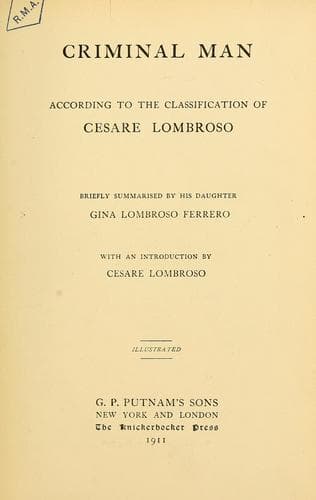
Criminal Man, According to the Classification of Cesare LombrosoLombroso, Gina
Science
Criminal Man, According to the Classification of Cesare Lombroso
Lombroso, Gina
Criminal anthropology; Criminology
It is a well-known fact that a great many men of genius have suffered
from epileptic seizures and a still greater number from those symptoms
which we have shown to be the equivalent of the seizure. Julius Cæsar,
St. Paul, Mahomet, Petrarca, Swift, Peter the Great, Richelieu,
Napoleon, Flaubert, Guerrazzi, De Musset, and Dostoyevsky were subject
to fits of morbid rage; and Swift, Marlborough, Faraday, and Dickens
suffered from vertigo.
But it is in the descriptions written by men of genius of their methods
of working and creating that we find the strongest resemblance to the
different phenomena of epilepsy, which have already been described in
detail in this work, in the part treating of the connection between
epilepsy and crime. While writing his poems, Tasso appeared to be out of
his senses; Alfieri felt everything go dark around him; Lagrange's pulse
became irregular; Milton, Leibnitz, Cujas, Rossini, and Thomas could
work only under special conditions. Others have encouraged inspiration
by using those stimulants which provoke epileptic attacks. Baudelaire
made use of hashish; and wine evoked the creative spirit in Gluck,
Gerard de Nerval, Verlaine, De Musset, Hoffmann, Burns, Coleridge, Poe,
Byron, Praga, and Carducci. Gluck was wont to declare that he valued
money only because it enabled him to procure wine, and that he loved
wine because it inspired him and transported him to the seventh heaven.
Schiller was satisfied with cider; and Goethe could not work unless he
felt the warmth of a ray of sunlight on his head. Many have asserted
that their writings, inventions, and solutions of difficult problems
have been done in a state of unconsciousness. Mozart confessed that he
composed in his dreams, and Lamartine and Alfieri made similar
statements. The _Henriade_ was suggested to Voltaire in a dream; Newton
and Cardano solved the most difficult problems in a similar manner; and
Mrs. Beecher Stowe, George Eliot, and George Sand asserted that their
novels had been written in a dream-like state, and that they themselves
were ignorant of the ultimate fate of their personages. In a preface to
one of her books Mrs. Beecher Stowe even went to the length of denying
her authorship. Socrates and Tolstoi declared that their works were
written in a condition of semi-unconsciousness; Leopardi, that he
followed an inspiration; and Dante described the source of his genius in
those beautiful lines:
"... quando
Amore spira, noto, ed a quel modo
Che detta dentro, vo significando."
"When love inspires, I write,
And put my thoughts as it dictates in me."
"I call inspiration," says Beethoven, "that mysterious state during
which the whole world seems to form one vast harmony, and all the forces
of Nature become instruments, when every sentiment and thought resounds
within me, a shudder thrills through my frame, and every hair on my
head stands on end."
Public-domain text, read in full here on John Shaqi.
Reviews
Reviews
No reviews yet
Be the first to share your thoughts on this work.
Elsewhere in the archive
Join the Discussion
Join the discussion
Sign in to leave a comment or review.
Sign InorCreate an account