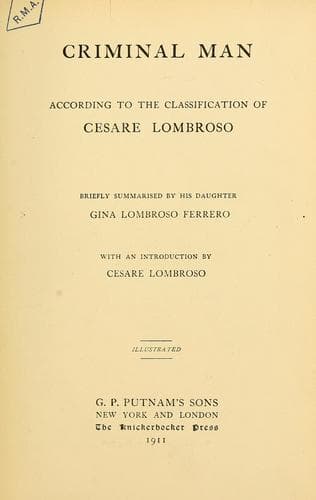
Criminal Man, According to the Classification of Cesare LombrosoLombroso, Gina
Science
Criminal Man, According to the Classification of Cesare Lombroso
Lombroso, Gina
Criminal anthropology; Criminology
The strange pathological conditions resulting from chronic alcoholism
give rise to other fearful hallucinations. Cutaneous anæsthesia and
alcoholic anaphrodisia make the sufferers fancy they have lost the
generative organs, nose, legs, etc.; dyspepsia, exhaustion, and paresis,
that they have been poisoned or are being persecuted. The reaction
following excessively prolonged stimuli causes furious lypemania and
gloomy fancies. Sometimes chronic inebriates believe that they are
accused of imaginary crimes and loaded with chains amid heaps of
corpses. They implore mercy and try to kill themselves in order to
escape from their shame; or they remain motionless, bewildered, and
terrified. Not infrequently, because of the profound faith, which,
unlike many other lunatics, they have in their hallucinations, they pass
from melancholy broodings to a fit of mad energy, often of a homicidal
or suicidal nature. They imagine they are struggling with thieves or
wild beasts and hurl themselves from the window or rush naked through
the streets, killing the first person that crosses their path. In some,
this delirium of energy breaks out suddenly like an epileptic attack,
which it resembles in its brevity and intensity. With hair standing on
end, they rush about like savage beasts, grinding their teeth, biting,
rending their clothes, or tearing up the sod, or hurling themselves from
some height. These symptoms are preceded by vertigo, periodical
cephalalgia, and flushing of the face, and are manifested more
frequently by those who are already predisposed through trauma to the
head, or through typhus or heredity, or after great agitation and
prolonged fasting, and often bear no relation to the quantity of alcohol
imbibed, which may be small, or to the general physical state; but
depend on cerebral irritation caused by chronic alcoholism. The attacks
may disappear in a few hours without leaving the slightest recollection
in the mind of the patient (Krafft-Ebing, p. 182). They are, in short, a
species of disguised epilepsy, and thus they may well be styled, since
true alcoholic epilepsy is noted in many inebriates, specially in
absinthe-drinkers.
_Apathy._ Another characteristic almost invariably found in inebriates
who have committed a crime, is a strange apathy and indifference, a
total lack of concern regarding their state--a trait common also to
ordinary criminals, but in a less marked degree. They make themselves at
home in prison without showing the faintest interest in their trial or
in the offence which has caused their arrest, and only when brought
before the judge do they rouse themselves for a moment from their
lethargy.
Public-domain text, read in full here on John Shaqi.
Reviews
Reviews
No reviews yet
Be the first to share your thoughts on this work.
Join the Discussion
Join the discussion
Sign in to leave a comment or review.
Sign InorCreate an account