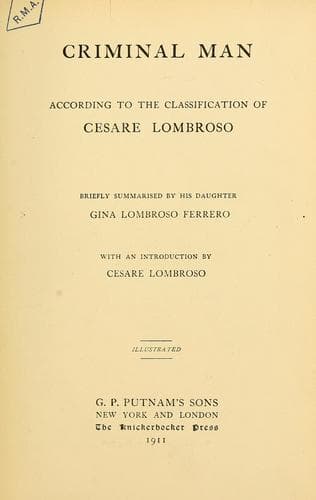
Criminal Man, According to the Classification of Cesare LombrosoLombroso, Gina
Science
Criminal Man, According to the Classification of Cesare Lombroso
Lombroso, Gina
Criminal anthropology; Criminology
A well-educated man, after a varied career as doctor, chemist, and
clerk, during which time he had been constantly dismissed from his posts
for drunkenness, met a policeman in the street and killed him, in the
belief that the officer wanted to arrest him. When taken to prison, the
first thing he did was to write to his mother begging her to send him
some pomade. When interrogated, he informed the examining magistrate
that the interrogatory was useless, since he had already chosen a fresh
trade, that of photographer. It was only after several months of total
abstinence in prison, that he began to come to his senses and to realise
the gravity of his situation. (Tardieu, _De la Folie_, 1870.)
_Contrast between Apathy and Impulsiveness._ This apathy alternates with
strange impulses, which, although strongly at variance with the
patient's former habits, he is unable to control, even when he is aware
that they are criminal.
_Crimes peculiar to Inebriates._ Since modification of the reproductive
organs is a common cause of hallucinations, inebriate criminals
frequently suffer from a species of erotic delirium, during which they
murder those whom they believe guilty of offences against
themselves--generally their wives or mistresses. This is partly owing to
the sexual nature of their hallucinations and partly to the wretchedness
of their homes, which are in such striking contrast to the rosy dreams
inspired by alcohol and which tend to increase the melancholy natural to
drunkards. They imagine they are being deceived and their impotence
derided, the most innocent gestures being interpreted as deadly insults.
In the prison at Turin, my father had under observation two of these
unfortunate beings, one a man of sixty and the other quite young. Both
had murdered their wives with the most revolting cruelty, because they
believed them to be unfaithful, although in reality both the women led
blameless lives.
_Course of the Disease._ The continued abuse of alcohol ends at last in
complete dementia or general pseudo-paralysis. The body is at first
obese, but rapidly loses flesh, the skin becomes greasy and damp, owing
to hypersecretion of the sebaceous and sudoriparous glands, and soils
the garments. Memory becomes enfeebled, speech uncertain and defective
(dysarthria), the association of ideas sluggish, sensibility blunted,
perception confused, judgment erroneous, and every species of regular
and continued application impossible. The earlier hallucinations
reappear, but in a less vivid form and only at long intervals; then
paralysis more or less rapidly becomes general and ends in death.
EPILEPSY
Public-domain text, read in full here on John Shaqi.
Reviews
Reviews
No reviews yet
Be the first to share your thoughts on this work.
Join the Discussion
Join the discussion
Sign in to leave a comment or review.
Sign InorCreate an account