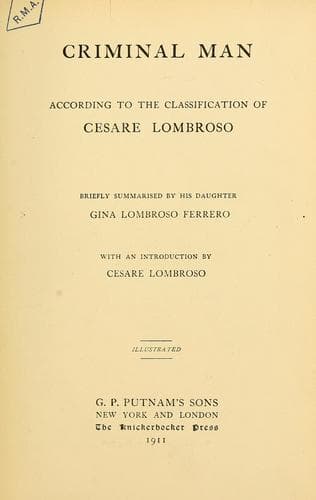
Criminal Man, According to the Classification of Cesare LombrosoLombroso, Gina
Science
Criminal Man, According to the Classification of Cesare Lombroso
Lombroso, Gina
Criminal anthropology; Criminology
Cumano, Verano, Guglielmotti, Harry, Curti, Milani, Brenner, Mari,
Zucca, Bechis, Bouley, Tacco, Berruto and Sand, and Camicia, Vinci, and
Leoni (these last three women), all attacked their victims single-handed
and in public.
In the case of Chalanton, the woman he had rescued by marriage from a
low life, not content with betraying her benefactor, covered him in
public with abuse and persecuted him with anonymous accusations. His
demand for a separation was unsuccessful and at last, finding himself,
in spite of his integrity, involved in a scandalous action, in which his
wife figured as a go-between, and tormented by public curiosity and the
implacable questionings of reporters, he murdered the cause of all his
misfortunes. Another murderer, Del Prete, was prompted to kill his
victim, an old woman with a reputation for witchcraft, because he
believed she had caused the illness of his mother, to whom he was
greatly attached.
The motive for the crime is generally a serious one and in most cases
immediately precedes it. Bouley committed his crime only a few hours
after receiving the news which prompted it; Bounin, Bechis, and Verano,
only a few minutes; Milani, twenty-four hours, Zucca eight hours;
Curti, a few days. Thus the crime is seldom premeditated, or if so, for
only a short space of time, never for months or years.
=FIG. 21
BRIGAND CASERIO
(see page 119)=
Homicide forms 91% of the criminality of this group of offenders. There
is a certain proportion also of infanticide, owing to the prevailing
prejudice which condemns immorality more harshly when the results are
evident. Arson and theft form only 2%. Such cases are however possible.
A young girl, whom my father had under observation in prison, seeing her
family in dire poverty, committed arson in order to get the insurance
money.
In another case a woman of refinement, education, and of gentle
disposition, who had fallen from prosperity into extreme want, stole in
order to pay her son's school-fees. When arrested, she refused to give
her name so that the lad should not be dishonoured, and her identity
might never have been discovered had she not been recognised by a lawyer
in court. She died of a broken heart a few days after her trial.
PART II
CRIME, ITS ORIGIN, CAUSE, AND CURE
CHAPTER I
_ORIGIN AND CAUSES OF CRIME_
In order to determine the origin of actions which we call criminal, we
shall be forced to hark back to a very remote period in the history of
the human race. In all the epochs of which records exist, we find traces
of criminal actions. In fact, if we study minutely the customs of savage
peoples, past and present, we find that many acts that are now
considered criminal by civilised nations were legitimate in former
times, and are to-day reputed such among primitive races.
Public-domain text, read in full here on John Shaqi.
Reviews
Reviews
No reviews yet
Be the first to share your thoughts on this work.
Elsewhere in the archive
Join the Discussion
Join the discussion
Sign in to leave a comment or review.
Sign InorCreate an account