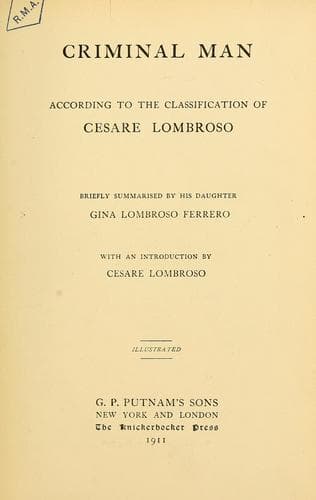
Criminal Man, According to the Classification of Cesare LombrosoLombroso, Gina
Science
Criminal Man, According to the Classification of Cesare Lombroso
Lombroso, Gina
Criminal anthropology; Criminology
The ætiology of crime, therefore, mingles with that of all kinds of
degeneration: rickets, deafness, monstrosity, hairiness, and cretinism,
of which crime is only a variation. It has, however, always been
regarded as a thing apart, owing to a general instinctive repugnance to
admit that a phenomenon, whose extrinsications are so extensive and
penetrate every fibre of social life, derives, in fact, from the same
causes as socially insignificant forms like rickets, sterility, etc. But
this repugnance is really only a sensory illusion, like many others of
widely diverse nature.
=FIG. 23
ART PRODUCTION FROM PRISON
(see page 135)=
=FIG. 24
A COMBAT BETWEEN BRIGANDS AND GENDARMES
Designed by a Criminal
(see page 135)=
_Pathological Origin of Crime._ The atavistic origin of crime is
certainly one of the most important discoveries of criminal
anthropology, but it is important only theoretically, since it merely
explains the phenomenon. Anthropologists soon realised how necessary it
was to supplement this discovery by that of the origin, or causes which
call forth in certain individuals these atavistic or criminal instincts,
for it is the immediate causes that constitute the practical nucleus of
the problem and it is their removal that renders possible the cure of
the disease.
These causes are divided into organic and external factors of crime: the
former remote and deeply rooted, the latter momentary but frequently
determining the criminal act, and both closely related and fused
together.
Heredity is the principal organic cause of criminal tendencies. It may
be divided into two classes: indirect heredity from a generically
degenerate family with frequent cases of insanity, deafness, syphilis,
epilepsy, and alcoholism among its members; direct heredity from
criminal parentage.
_Indirect Heredity._ Almost all forms of chronic, constitutional
diseases, especially those of a nervous character: chorea, sciatica,
hysteria, insanity, and above all, epilepsy, may give rise to
criminality in the descendants.
Of 559 soldiers convicted of offences, examined by Brancaleone Ribaudo,
10% had epileptic parents. According to Dejerine, this figure reaches
74.6% among criminal epileptics. Arthritis and gout have been known to
generate criminality in the descendants. But the most serious, and at
the same time most common, form of indirect heredity is alcoholism,
which, contrary to general belief, wreaks destruction in all classes of
society, amongst the rich and poor without distinction of sex, for
alcohol may insinuate itself everywhere under the most refined and
pleasant disguises, in liqueurs, sweets, and coffee.
According to calculations made by my father, 20% of Italian criminals
descend from inebriate families; according to Penta the percentage is 27
and in dangerous criminals, 33%. The Jukes family, of whom we shall
speak later, descended from a drunkard.
Public-domain text, read in full here on John Shaqi.
Reviews
Reviews
No reviews yet
Be the first to share your thoughts on this work.
Elsewhere in the archive
Join the Discussion
Join the discussion
Sign in to leave a comment or review.
Sign InorCreate an account