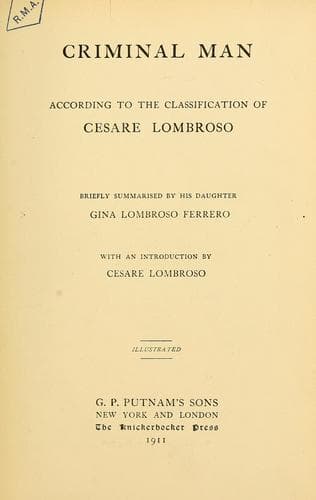
Criminal Man, According to the Classification of Cesare LombrosoLombroso, Gina
Science
Criminal Man, According to the Classification of Cesare Lombroso
Lombroso, Gina
Criminal anthropology; Criminology
The Hebrew Sheltering Guardian Society is an orphanage for the Jews,
managed with rare insight and intelligence by Mr. Lewisohn. The
Institute being founded for orphans only, there is no limit as to age or
condition. Infants and young people, diseased and healthy, intelligent
and mentally deficient, normal and abnormal, good and bad, are all
welcome. In order to prevent the overcrowding of the institution and to
provide homes for as many children as possible, a committee has been
organised for the purpose of finding homes in private families for all
children under six years of age and for those who are sickly and
delicate. A certain proportion are adopted, and others are boarded out,
but the sum paid for their keep is always less than it would cost to
place them in a school; and there is, moreover, always a chance of their
being adopted later. At the age of six, all healthy and robust children
enter the Institute, which becomes their home, providing them with
board, lodging, clothing, moral and religious instruction, and training
in some kind of work, but in order that they shall mix with other
children, they are educated at the public schools, and the consequent
saving in money and space enables the Institute to receive a larger
number of children than it otherwise could.
Instead of the uniform customary in such institutions which serves to
accentuate in a humiliating way the contrast between the inmates and
more fortunate children who possess parents and homes, the clothing worn
by the orphans of the Hebrew Sheltering Guardian Society is varied in
colour and style. Girls skilled in the use of their needle alter their
dresses to suit their individual tastes, and are allowed to sew, either
gratis or for payment, for the boys and other girls of the Institute,
who are unable or unwilling to make these alterations themselves. When
school-tasks are finished, boys and girls of over twelve are allowed to
engage in light occupations--needlework, writing, etc., supplied by the
Institute to enable them to earn a little pocket-money and learn to
spend it properly.
When the boys and girls have passed all the standards of the elementary
schools, they enter trade schools, where they remain until they are
proficient in some craft which will enable them to earn a living. Those
who show decided intellectual or business aptitudes are sent to colleges
or commercial schools.
The children are encouraged to take an interest in social and political
life by the foundation of a miniature republic, or rather two separate
republics, one for the boys and the other for the girls, each with its
president, a boy or a girl according to the case. In reality, however,
they are under the management of a lady, who devises various
amusements for the children, reading, games, etc., teaches them music
and drawing, and helps the little President to organise entertainments
to which outsiders, relatives, and schoolfellows are invited.
=FIG. 17
Signatures of Criminals=
Public-domain text, read in full here on John Shaqi.
Reviews
Reviews
No reviews yet
Be the first to share your thoughts on this work.
Elsewhere in the archive
Join the Discussion
Join the discussion
Sign in to leave a comment or review.
Sign InorCreate an account