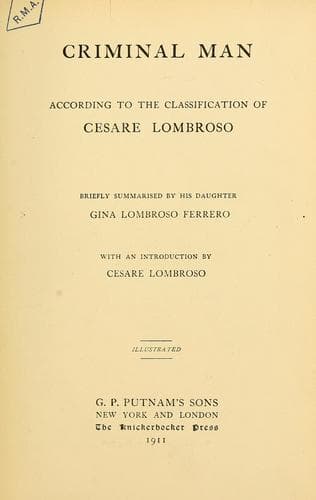
Criminal Man, According to the Classification of Cesare LombrosoLombroso, Gina
Science
Criminal Man, According to the Classification of Cesare Lombroso
Lombroso, Gina
Criminal anthropology; Criminology
To ensure careful supervision of all the poor quarters, the Salvation
Army has divided them into twenty slums, in each of which they have
established their Headquarters and send out their soldiers to
investigate and assist cases of poverty and misery of every kind. Each
slum Headquarters is provided with halls for meetings, rooms for the
officials, a Kindergarten, and Dormitories which also serve as shelters
or hospitals for urgent cases. In one year 26,290 families were visited
by the Army and 38,290 received assistance. Employment, temporary and
permanent, was found for 66,621 persons.
All poor of whatever condition, nationality, or religion, whether honest
or criminal, on applying to the nearest of these Headquarters may be
sure of finding sympathy and help.
Five Homes have been founded by the Army for waifs and children whose
mothers are obliged to go out to work, and 225 Accommodations where
children may find a temporary or permanent home.
A special squad of soldiers has recently undertaken work amongst
prisoners with great success. In two months they visited 43 prisons,
wrote 1732 letters to prisoners, and distributed 10,000 pamphlets.
19,882 prisoners attended meetings held in the prisons, 194 articles of
clothing were distributed, 128 persons provided with work on their
release and 300 with sleeping accommodation.
In South America the Army has founded similar institutions, which
embrace others, such as hospitals, etc., suited to the needs of each
place.
Other benevolent organisations which seem to me admirable, are the
Sisterhoods founded twenty years ago by the Rabbi Gottheil. These
Sisterhoods, as may be assumed from the name, are entirely directed by
women. They consist of premises, sometimes annexed to the synagogue; at
others, situated independently, which form a species of Headquarters for
the philanthropical work done in the surrounding districts. The
Sisterhood is open day and night to all the poor who are in need of help
of any kind. There is a resident Directress, under whose orders a number
of ladies take turns in helping applicants. The Sisterhoods were founded
on the principle that human beings are capable of doing the maximum
amount of good to others when they follow their own particular
tendencies and try to utilise their individual talents in satisfying the
intellectual, moral, or recreative needs of the poor. Some of the ladies
devote themselves to simple legal questions, tracing an absent husband
or wife, registering births, taking unruly children to the Juvenile
Courts, or looking after them, etc. Others take charge of medical
matters, arrange for the admission of children or adults to the
hospitals, etc.; others organise entertainments, teach singing, drawing,
needlework, and cooking classes. The premises are used in turn by
working-girls learning sewing, or others rehearsing some play or opera
chorus. Almost all the Sisterhoods possess a permanent Kindergarten for
Public-domain text, read in full here on John Shaqi.
Reviews
Reviews
No reviews yet
Be the first to share your thoughts on this work.
Elsewhere in the archive
Join the Discussion
Join the discussion
Sign in to leave a comment or review.
Sign InorCreate an account