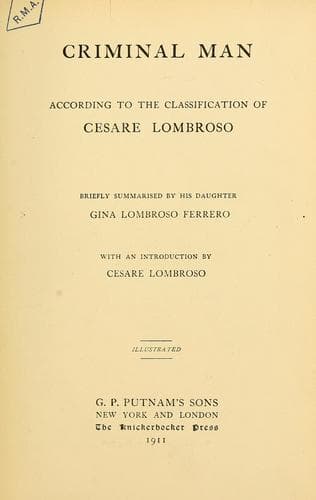
Criminal Man, According to the Classification of Cesare LombrosoLombroso, Gina
Science
Criminal Man, According to the Classification of Cesare Lombroso
Lombroso, Gina
Criminal anthropology; Criminology
_METHODS FOR THE CURE AND REPRESSION OF CRIME_
Preventive methods, the careful training of children, and assistance
rendered to adults in critical moments of their lives, may diminish
crime, but cannot suppress it entirely. Such methods should be
supplemented by institutions which undertake to cure criminals, while
protecting society from their attacks, and by others for the segregation
of incurable offenders, who should be rendered as useful as possible in
order to minimise in every way the injury they inflict on the community.
Although unjustly accused of desiring to revolutionise penal
jurisprudence, criminal anthropologists realised from the very beginning
that laws cannot be changed before there is a corresponding change in
public opinion, and that even equitable modifications in the laws, if
too sudden, are always fraught with dangerous consequences. Therefore,
instead of a radical change in the penal code, their aim was to effect
a few slight alterations in the graduation of penalties, in accordance
with age, sex, and the degree of depravity manifested by culprits in
their offences. They also counselled certain modifications in the
application of the laws, the reformation according to modern ideas, of
prisons, asylums, penal colonies, and all institutions for the
punishment and redemption of offenders, and an extensive application of
those penalties devised in past ages as substitutes for imprisonment,
which have the advantage of corrupting the culprit less, and costing the
community very little.
_Juvenile Offenders._ Young people, and, above all, children, should be
dealt with separately by special legislative methods.
With the exception of England, where quite recently a children's court
has been opened at Westminster, special tribunals for the young are
unknown in Europe. However, in modern times, the penal codes of nearly
every European State make marked allowance for the age of offenders, and
where there is no differentiation in the laws, the magistrate uses his
own discretion and refuses in many cases to convict juvenile offenders,
even when they are guilty of serious offences.
These instinctive methods of dealing with the young have many drawbacks:
1. Without special courts, children guilty of simple acts of
insubordination or petty offences (thefts of fruit or riding in trams
and trains without paying the fare) which cannot be separated by a hard
and fast line from ordinary childish pranks, come into contact with
criminal types in court or in prison, and this is greatly detrimental to
them morally. If naturally inclined to dishonesty, they run the risk of
developing into occasional criminals and of losing all sense of shame:
or if really honest, contact with bad characters cannot fail to shock
and perturb them, even though their stay in prison be only a short one.
Public-domain text, read in full here on John Shaqi.
Reviews
Reviews
No reviews yet
Be the first to share your thoughts on this work.
Elsewhere in the archive
Join the Discussion
Join the discussion
Sign in to leave a comment or review.
Sign InorCreate an account