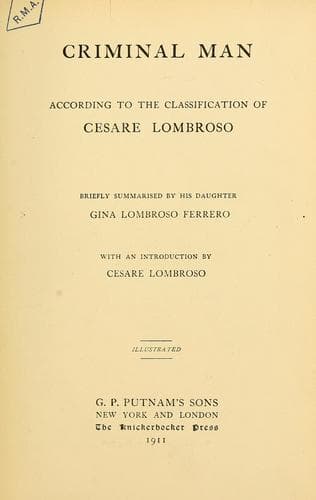
Criminal Man, According to the Classification of Cesare LombrosoLombroso, Gina
Science
Criminal Man, According to the Classification of Cesare Lombroso
Lombroso, Gina
Criminal anthropology; Criminology
The oldest and most celebrated of these reformatories, that founded at
Elmira by Brockway, owed its inspiration to my father's book _Criminal
Man_ and is the first reformatory that has been instituted on similar
principles.
The convicts admitted to Elmira are young men between the ages of
sixteen and thirty, convicted for the first time of any offence, except
those of the most serious kind. The Administrative Council is invested
with unlimited powers for determining the period of detention and may
release prisoners long before the expiration of their sentence.
Each newcomer has a bath, dons the uniform of the Institute, is
photographed, registered, medically examined, and finally shut up in a
cell to meditate upon his offence. During this time the superintendent
obtains all the available information concerning his character,
environment, and the probable causes that have led to his crime, and
this information serves as a basis for the cure. According to the
aptitude and culture of the prisoner, he is placed in a technical or
industrial class, where he learns some trade which will enable him to
become honestly self-supporting on his release. He is immediately
acquainted with his duties and rights and the conditions under which he
may regain his liberty.
Education in the Reformatory consists of instruction in general
knowledge and special training in some trade. Moral and intellectual
progress is stimulated by the publication of a weekly review, _The
Summary_, which gives a report on political matters and the news of the
Reformatory.
The convicts are divided into three categories: good, middling, and bad.
The transference from the second to the first class entails certain
privileges, especially those respecting communication with the outer
world, the right to receive visitors, to have books, and to eat at a
common table instead of partaking of a solitary meal in a cell. Those
who obtain the highest marks for good conduct are at liberty to walk
about the grounds and are entrusted with confidential missions, such as
the supervision of the other convicts. Bad conduct marks cause prisoners
to be transferred from a higher to the lowest division, where they are
obliged to perform the rudest labour.
First-class convicts are purposely exposed to temptations of various
kinds, and when they have passed through this ordeal triumphantly, they
obtain a conditional release. This cannot take place, however, until the
prisoner is provided with regular employment of some kind, procured by
his own exertions, through friends, or by the director of the
Reformatory.
For six months after his release he is obliged to give an account of
himself regularly in the manner prescribed by the Director; after one
year absolute liberty is regained.
In order to reduce the working expenses of the Reformatory as much as
possible, all posts, even that of superintendent or teacher in the
technical schools, are filled by the convicts.
PENITENTIARIES
Public-domain text, read in full here on John Shaqi.
Reviews
Reviews
No reviews yet
Be the first to share your thoughts on this work.
Elsewhere in the archive
Join the Discussion
Join the discussion
Sign in to leave a comment or review.
Sign InorCreate an account