Suppose that a piano were conscious of sound, and of nothing else. It
would become acquainted with a system of nature entirely composed
of sounds, and the laws of nature would be the laws of melody and of
harmony. It might acquire endless ideas of likeness and unlikeness, of
succession, of similarity and dissimilarity, but it could attain to no
conception of space, of distance, or of resistance; or of figure, or
of motion.
The piano might then reason thus: All my knowledge consists of sounds
and the perception of the relations of sounds; now the being of sound
is to be heard; and it is inconceivable that the existence of the
sounds I know, should depend upon any other existence than that of the
mind of a hearing being.
This would be quite as good reasoning as Berkeley's, and very sound
and useful, so far as it defines the limits of the piano's faculties.
But for all that, pianos have an existence quite apart from sounds,
and the auditory consciousness of our speculative piano would be
dependent, in the first place, on the existence of a "substance" of
brass, wood, and iron, and, in the second, on that of a musician. But
of neither of these conditions of the existence of his consciousness
would the phenomena of that consciousness afford him the slightest
hint.
So that while it is the summit of human wisdom to learn the limit of
our faculties, it may be wise to recollect that we have no more right
to make denials, than to put forth affirmatives, about what lies
beyond that limit. Whether either mind, or matter, has a "substance"
or not, is a problem which we are incompetent to discuss; and it is
just as likely that the common notions upon the subject should be
correct as any others. Indeed, Berkeley himself makes Philonous wind
up his discussions with Hylas, in a couple of sentences which aptly
express this conclusion:--
"You see, Hylas, the water of yonder fountain, how it is
forced upwards in a round column to a certain height, at which
it breaks and falls back into the basin from whence it rose;
its ascent as well as its descent proceeding from the same
uniform law or principle of gravitation. Just so, the same
principles which, at first view, lead to scepticism, pursued
to a certain point, bring men back to common sense."
THE END.
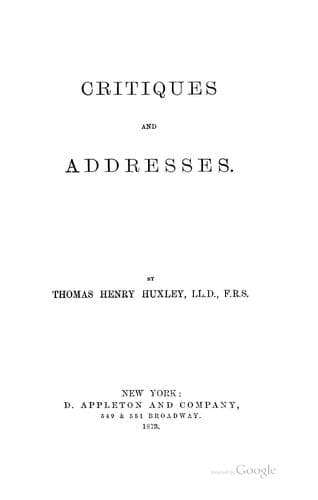
End of Project Gutenberg's Critiques and Addresses, by Thomas Henry Huxley
Public-domain text, read in full here on John Shaqi.
Reviews
Reviews
No reviews yet
Be the first to share your thoughts on this work.
Elsewhere in the archive
Join the Discussion
Join the discussion
Sign in to leave a comment or review.
Sign InorCreate an account