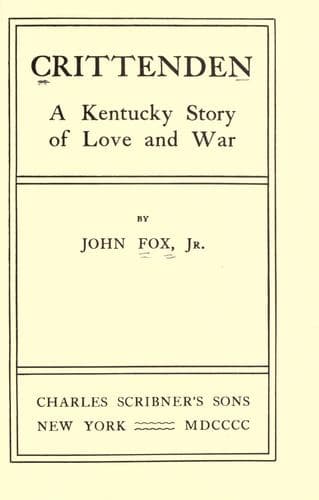
Crittenden: A Kentucky Story of Love and WarFox, John, Jr.
General
Crittenden: A Kentucky Story of Love and War
Fox, John, Jr.
Kentucky -- Fiction; Spanish-American War, 1898 -- Fiction
"I can eat strawberries, now." And she blushed again. Phyllis had been
living on bacon and corn-bread, she confessed shamefacedly, because
Trooper Basil was living on bacon and hardtack--little dreaming that the
food she forced upon herself in this sacrificial way was being swallowed
by that hearty youngster with a relish that he would not have known at
home for fried chicken and hot rolls.
"Yes," laughed Mrs. Crittenden. "You can eat strawberries now. You can
balance them against his cocoanuts."
Phyllis picked up the paper then, with a cry of surprise--the name
signed to the article was Grafton, whom she had seen at the recruiting
camp. And then she read the last paragraph that the mother had not read
aloud, and she turned sharply away and stooped to a pink-bed, as though
she would pick one, and the mother saw her shoulders shaking with silent
sobs, and she took the child in her arms.
There was to be a decisive fight in a few days--the attack on
Santiago--that was what Phyllis had read. The Spaniard had a good
muster-roll of regulars and aid from Cervera's fleet; was well armed,
and had plenty of time to intrench and otherwise prepare himself for a
bloody fight in the last ditch.
So that, each day there was a relief to the night agony, which, every
morning, began straightway with the thought that the fight might be
going on at that very hour. Not once did Judith come near. She had been
ill, to be sure, but one day Mrs. Crittenden met her on the way to town
and stopped her in the road; but the girl had spoken so strangely that
the mother drove on, at loss to understand and much hurt. Next day she
learned that Judith, despite her ill health and her father's protests,
had gone to nurse the sick and the wounded--what Phyllis plead in vain
to do. The following day a letter came from Mrs. Crittenden's elder son.
He was well, and the mother must not worry about either him or Basil. He
did not think there would be much fighting and, anyhow, the great risk
was from disease, and he feared very little from that. Basil would be
much safer as an aid on a General's staff. He would get plenty to eat,
would be less exposed to weather, have no long marches--as he would be
mounted--and no guard duty at all hours of day and night. And, moreover,
he would probably be less constantly exposed to bullets. So she must not
worry about him. Not one word was there about Judith--not even to ask
how she was, which was strange. He had said nothing about the girl when
he told his mother good-by; and when she broached the subject, he
answered sadly:
"Don't, mother; I can't say a word--not a word."
Public-domain text, read in full here on John Shaqi.
Reviews
Reviews
No reviews yet
Be the first to share your thoughts on this work.
Elsewhere in the archive
Join the Discussion
Join the discussion
Sign in to leave a comment or review.
Sign InorCreate an account