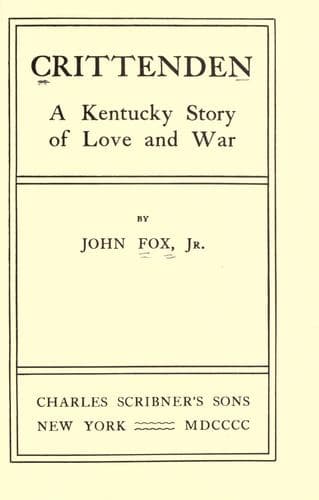
Crittenden: A Kentucky Story of Love and WarFox, John, Jr.
General
Crittenden: A Kentucky Story of Love and War
Fox, John, Jr.
Kentucky -- Fiction; Spanish-American War, 1898 -- Fiction
* * * * *
It was fiercer firing now than ever. The Spaniards were in the second
line of trenches and were making a sortie. Under the hill sat Grafton
and another correspondent while the storm of bullets swept over them.
Grafton was without glasses--a Mauser had furrowed the skin on the
bridge of his nose, breaking his spectacle-frame so that one glass
dropped on one side of his nose and the other on the other. The other
man had several narrow squeaks, as he called them, and, even as they
sat, a bullet cut a leaf over his head and it dropped between the pages
of his note-book. He closed the book and looked up.
"Thanks," he said. "That's just what I want--I'll keep that."
"I observe," said Grafton, "that the way one of these infernal bullets
sounds depends entirely on where you happen to be when you hear it. When
a sharpshooter has picked you out and is plugging at you, they are
intelligent and vindictive. Coming through that bottom, they were for
all the world like a lot of nasty little insects. And listen to 'em
now." The other man listened. "Hear 'em as they pass over and go out of
hearing. That is for all the world like the last long note of a meadow
lark's song when you hear him afar off and at sunset. But I notice that
simile didn't occur to me until I got under the lee of this hill." He
looked around. "This hill will be famous, I suppose. Let's go up
higher." They went up higher, passing a crowd of skulkers, or men in
reserve--Grafton could not tell which--and as they went by a soldier
said:
"Well, if I didn't have to be here, I be damned if I wouldn't like to
see anybody get me here. What them fellers come fer, I can't see."
The firing was still hot when the two men got up to the danger line, and
there they lay down. A wounded man lay at Grafton's elbow. Once his
throat rattled and Grafton turned curiously.
"That's the death-rattle," he said to himself, and he had never heard a
death-rattle before. The poor fellow's throat rattled again, and again
Grafton turned.
"I never knew before," he said to himself, "that a dying man's throat
rattled but once." Then it flashed on him with horror that he should
have so little feeling, and he knew it at once as the curious
callousness that comes quickly to toughen the heart for the sights of
war. A man killed in battle was not an ordinary dead man at all--he
stirred no sensation at all--no more than a dead animal. Already he had
heard officers remarking calmly to one another, and apparently without
feeling:
Public-domain text, read in full here on John Shaqi.
Reviews
Reviews
No reviews yet
Be the first to share your thoughts on this work.
Elsewhere in the archive
Join the Discussion
Join the discussion
Sign in to leave a comment or review.
Sign InorCreate an account