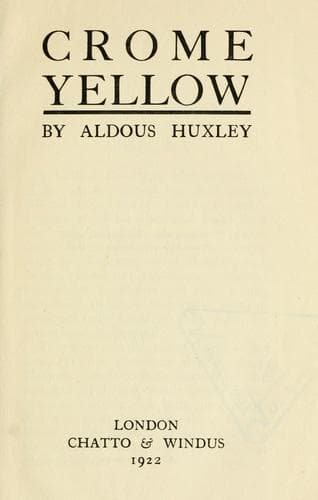
Country homes -- Fiction; England -- Fiction; Humorous stories; Intellectuals -- Fiction; Satire
Oh, these rags and tags of other people’s making! Would he ever be able
to call his brain his own? Was there, indeed, anything in it that was
truly his own, or was it simply an education?
He walked slowly round the water’s edge. In an embayed recess among
the surrounding yew trees, leaning her back against the pedestal of a
pleasantly comic version of the Medici Venus, executed by some nameless
mason of the seicento, he saw Mary pensively sitting.
“Hullo!” he said, for he was passing so close to her that he had to say
something.
Mary looked up. “Hullo!” she answered in a melancholy, uninterested
tone.
In this alcove hewed out of the dark trees, the atmosphere seemed to
Denis agreeably elegiac. He sat down beside her under the shadow of the
pudic goddess. There was a prolonged silence.
At breakfast that morning Mary had found on her plate a picture postcard
of Gobley Great Park. A stately Georgian pile, with a facade sixteen
windows wide; parterres in the foreground; huge, smooth lawns receding
out of the picture to right and left. Ten years more of the hard times
and Gobley, with all its peers, will be deserted and decaying. Fifty
years, and the countryside will know the old landmarks no more. They
will have vanished as the monasteries vanished before them. At the
moment, however, Mary’s mind was not moved by these considerations.
On the back of the postcard, next to the address, was written, in Ivor’s
bold, large hand, a single quatrain.
“Hail, maid of moonlight! Bride of the sun, farewell!
Like bright plumes moulted in an angel’s flight,
There sleep within my heart’s most mystic cell
Memories of morning, memories of the night.”
There followed a postscript of three lines: “Would you mind asking one
of the housemaids to forward the packet of safety-razor blades I left in
the drawer of my washstand. Thanks.--Ivor.”
Seated under the Venus’s immemorial gesture, Mary considered life
and love. The abolition of her repressions, so far from bringing the
expected peace of mind, had brought nothing but disquiet, a new and
hitherto unexperienced misery. Ivor, Ivor...She couldn’t do without him
now. It was evident, on the other hand, from the poem on the back of the
picture postcard, that Ivor could very well do without her. He was at
Gobley now, so was Zenobia. Mary knew Zenobia. She thought of the last
verse of the song he had sung that night in the garden.
“Le lendemain, Phillis peu sage
Aurait donne moutons et chien
Pour un baiser que le volage
A Lisette donnait pour rien.”
Mary shed tears at the memory; she had never been so unhappy in all her
life before.
Public-domain text, read in full here on John Shaqi.
Reviews
Reviews
No reviews yet
Be the first to share your thoughts on this work.
Elsewhere in the archive
Join the Discussion
Join the discussion
Sign in to leave a comment or review.
Sign InorCreate an account