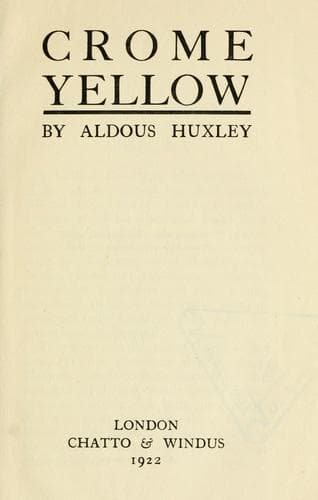
Country homes -- Fiction; England -- Fiction; Humorous stories; Intellectuals -- Fiction; Satire
Confronted by a picture, of which I could tell you all the known and
presumed history--the date when it was painted, the character of the
painter, the influences that had gone to make it what it was--I felt
none of that strange excitement and exaltation which is, as I am
informed by those who do feel it, the true aesthetic emotion. I felt
nothing but a certain interest in the subject of the picture; or more
often, when the subject was hackneyed and religious, I felt nothing but
a great weariness of spirit. Nevertheless, I must have gone on looking
at pictures for ten years before I would honestly admit to myself that
they merely bored me. Since then I have given up all attempts to take
a holiday. I go on cultivating my old stale daily self in the resigned
spirit with which a bank clerk performs from ten till six his daily
task. A holiday, indeed! I’m sorry for you, Gombauld, if you still look
forward to having a holiday.”
Gombauld shrugged his shoulders. “Perhaps,” he said, “my standards
aren’t as elevated as yours. But personally I found the war quite as
thorough a holiday from all the ordinary decencies and sanities, all the
common emotions and preoccupations, as I ever want to have.”
“Yes,” Mr. Scogan thoughtfully agreed. “Yes, the war was certainly
something of a holiday. It was a step beyond Southend; it was
Weston-super-Mare; it was almost Ilfracombe.”
CHAPTER XXVI.
A little canvas village of tents and booths had sprung up, just beyond
the boundaries of the garden, in the green expanse of the park. A crowd
thronged its streets, the men dressed mostly in black--holiday best,
funeral best--the women in pale muslins. Here and there tricolour
bunting hung inert. In the midst of the canvas town, scarlet and gold
and crystal, the merry-go-round glittered in the sun. The balloon-man
walked among the crowd, and above his head, like a huge, inverted
bunch of many-coloured grapes, the balloons strained upwards. With a
scythe-like motion the boat-swings reaped the air, and from the funnel
of the engine which worked the roundabout rose a thin, scarcely wavering
column of black smoke.
Denis had climbed to the top of one of Sir Ferdinando’s towers, and
there, standing on the sun-baked leads, his elbows resting on the
parapet, he surveyed the scene. The steam-organ sent up prodigious
music. The clashing of automatic cymbals beat out with inexorable
precision the rhythm of piercingly sounded melodies. The harmonies were
like a musical shattering of glass and brass. Far down in the bass
the Last Trump was hugely blowing, and with such persistence, such
resonance, that its alternate tonic and dominant detached themselves
from the rest of the music and made a tune of their own, a loud,
monotonous see-saw.
Public-domain text, read in full here on John Shaqi.
Reviews
Reviews
No reviews yet
Be the first to share your thoughts on this work.
Elsewhere in the archive
Join the Discussion
Join the discussion
Sign in to leave a comment or review.
Sign InorCreate an account