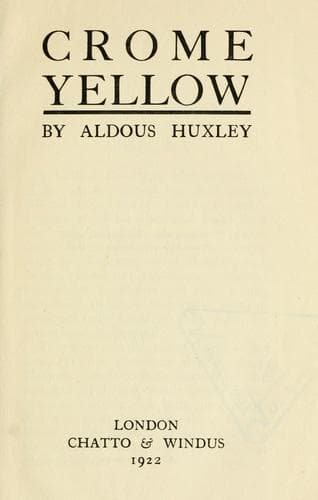
Country homes -- Fiction; England -- Fiction; Humorous stories; Intellectuals -- Fiction; Satire
It was after ten o’clock. The dancers had already dispersed and the
last lights were being put out. To-morrow the tents would be struck, the
dismantled merry-go-round would be packed into waggons and carted away.
An expanse of worn grass, a shabby brown patch in the wide green of the
park, would be all that remained. Crome Fair was over.
By the edge of the pool two figures lingered.
“No, no, no,” Anne was saying in a breathless whisper, leaning
backwards, turning her head from side to side in an effort to escape
Gombauld’s kisses. “No, please. No.” Her raised voice had become
imperative.
Gombauld relaxed his embrace a little. “Why not?” he said. “I will.”
With a sudden effort Anne freed herself. “You won’t,” she retorted.
“You’ve tried to take the most unfair advantage of me.”
“Unfair advantage?” echoed Gombauld in genuine surprise.
“Yes, unfair advantage. You attack me after I’ve been dancing for two
hours, while I’m still reeling drunk with the movement, when I’ve lost
my head, when I’ve got no mind left but only a rhythmical body! It’s as
bad as making love to someone you’ve drugged or intoxicated.”
Gombauld laughed angrily. “Call me a White Slaver and have done with
it.”
“Luckily,” said Anne, “I am now completely sobered, and if you try and
kiss me again I shall box your ears. Shall we take a few turns round the
pool?” she added. “The night is delicious.”
For answer Gombauld made an irritated noise. They paced off slowly, side
by side.
“What I like about the painting of Degas...” Anne began in her most
detached and conversational tone.
“Oh, damn Degas!” Gombauld was almost shouting.
From where he stood, leaning in an attitude of despair against the
parapet of the terrace, Denis had seen them, the two pale figures in
a patch of moonlight, far down by the pool’s edge. He had seen the
beginning of what promised to be an endless passionate embracement,
and at the sight he had fled. It was too much; he couldn’t stand it. In
another moment, he felt, he would have burst into irrepressible tears.
Dashing blindly into the house, he almost ran into Mr. Scogan, who was
walking up and down the hall smoking a final pipe.
“Hullo!” said Mr. Scogan, catching him by the arm; dazed and hardly
conscious of what he was doing or where he was, Denis stood there for
a moment like a somnambulist. “What’s the matter?” Mr. Scogan went on.
“you look disturbed, distressed, depressed.”
Denis shook his head without replying.
“Worried about the cosmos, eh?” Mr. Scogan patted him on the arm. “I
know the feeling,” he said. “It’s a most distressing symptom. ‘What’s
the point of it all? All is vanity. What’s the good of continuing to
function if one’s doomed to be snuffed out at last along with everything
else?’ Yes, yes. I know exactly how you feel. It’s most distressing if
one allows oneself to be distressed. But then why allow oneself to be
distressed? After all, we all know that there’s no ultimate point. But
what difference does that make?”
Public-domain text, read in full here on John Shaqi.
Reviews
Reviews
No reviews yet
Be the first to share your thoughts on this work.
Elsewhere in the archive
Join the Discussion
Join the discussion
Sign in to leave a comment or review.
Sign InorCreate an account