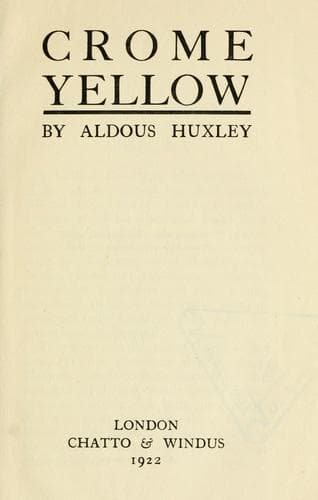
Country homes -- Fiction; England -- Fiction; Humorous stories; Intellectuals -- Fiction; Satire
“At this very moment,” he went on, “the most frightful horrors are taking
place in every corner of the world. People are being crushed, slashed,
disembowelled, mangled; their dead bodies rot and their eyes decay with
the rest. Screams of pain and fear go pulsing through the air at the
rate of eleven hundred feet per second. After travelling for three
seconds they are perfectly inaudible. These are distressing facts; but
do we enjoy life any the less because of them? Most certainly we do not.
We feel sympathy, no doubt; we represent to ourselves imaginatively the
sufferings of nations and individuals and we deplore them. But, after
all, what are sympathy and imagination? Precious little, unless the
person for whom we feel sympathy happens to be closely involved in our
affections; and even then they don’t go very far. And a good thing too;
for if one had an imagination vivid enough and a sympathy sufficiently
sensitive really to comprehend and to feel the sufferings of other
people, one would never have a moment’s peace of mind. A really
sympathetic race would not so much as know the meaning of happiness.
But luckily, as I’ve already said, we aren’t a sympathetic race. At
the beginning of the war I used to think I really suffered, through
imagination and sympathy, with those who physically suffered. But after
a month or two I had to admit that, honestly, I didn’t. And yet I
think I have a more vivid imagination than most. One is always alone in
suffering; the fact is depressing when one happens to be the sufferer,
but it makes pleasure possible for the rest of the world.”
There was a pause. Henry Wimbush pushed back his chair.
“I think perhaps we ought to go and join the ladies,” he said.
“So do I,” said Ivor, jumping up with alacrity. He turned to Mr. Scogan.
“Fortunately,” he said, “we can share our pleasures. We are not always
condemned to be happy alone.”
CHAPTER XVII.
Ivor brought his hands down with a bang on to the final chord of his
rhapsody. There was just a hint in that triumphant harmony that the
seventh had been struck along with the octave by the thumb of the left
hand; but the general effect of splendid noise emerged clearly enough.
Small details matter little so long as the general effect is good. And,
besides, that hint of the seventh was decidedly modern. He turned round
in his seat and tossed the hair back out of his eyes.
“There,” he said. “That’s the best I can do for you, I’m afraid.”
Murmurs of applause and gratitude were heard, and Mary, her large china
eyes fixed on the performer, cried out aloud, “Wonderful!” and gasped
for new breath as though she were suffocating.
Public-domain text, read in full here on John Shaqi.
Reviews
Reviews
No reviews yet
Be the first to share your thoughts on this work.
Elsewhere in the archive
Join the Discussion
Join the discussion
Sign in to leave a comment or review.
Sign InorCreate an account