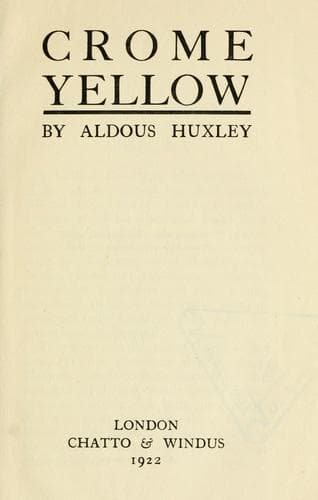
Country homes -- Fiction; England -- Fiction; Humorous stories; Intellectuals -- Fiction; Satire
“At any moment she might die; at any moment she might become Lady
Timpany. It was terrible, terrible. If she died, then he would die
too; he would go to seek her beyond the grave. If she became Lady
Timpany...ah, then! The solution of the problem would not be so simple.
If she became Lady Timpany: it was a horrible thought. But then suppose
she were in love with Timpany--though it seemed incredible that anyone
could be in love with Timpany--suppose her life depended on Timpany,
suppose she couldn’t live without him? He was fumbling his way along
this clueless labyrinth of suppositions when the clock struck twelve. On
the last stroke, like an automaton released by the turning clockwork, a
little maid, holding a large covered tray, popped out of the door that
led from the kitchen regions into the hall. From his deep arm-chair
George watched her (himself, it was evident, unobserved) with an idle
curiosity. She pattered across the room and came to a halt in front of
what seemed a blank expense of panelling. She reached out her hand and,
to George’s extreme astonishment, a little door swung open, revealing
the foot of a winding staircase. Turning sideways in order to get her
tray through the narrow opening, the little maid darted in with a rapid
crab-like motion. The door closed behind her with a click. A minute
later it opened again and the maid, without her tray, hurried back
across the hall and disappeared in the direction of the kitchen. George
tried to recompose his thoughts, but an invincible curiosity drew his
mind towards the hidden door, the staircase, the little maid. It was in
vain he told himself that the matter was none of his business, that to
explore the secrets of that surprising door, that mysterious staircase
within, would be a piece of unforgivable rudeness and indiscretion.
It was in vain; for five minutes he struggled heroically with his
curiosity, but at the end of that time he found himself standing in
front of the innocent sheet of panelling through which the little maid
had disappeared. A glance sufficed to show him the position of the
secret door--secret, he perceived, only to those who looked with
a careless eye. It was just an ordinary door let in flush with the
panelling. No latch nor handle betrayed its position, but an unobtrusive
catch sunk in the wood invited the thumb. George was astonished that he
had not noticed it before; now he had seen it, it was so obvious,
almost as obvious as the cupboard door in the library with its lines
of imitation shelves and its dummy books. He pulled back the catch and
peeped inside. The staircase, of which the degrees were made not
of stone but of blocks of ancient oak, wound up and out of sight.
A slit-like window admitted the daylight; he was at the foot of the
central tower, and the little window looked out over the terrace; they
were still shouting and splashing in the pool below.
Public-domain text, read in full here on John Shaqi.
Reviews
Reviews
No reviews yet
Be the first to share your thoughts on this work.
Elsewhere in the archive
Join the Discussion
Join the discussion
Sign in to leave a comment or review.
Sign InorCreate an account