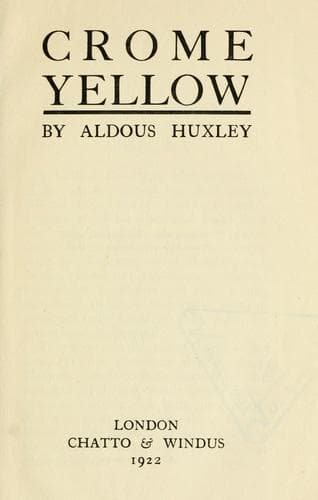
Country homes -- Fiction; England -- Fiction; Humorous stories; Intellectuals -- Fiction; Satire
“That’s the test for the literary mind,” said Denis; “the feeling of
magic, the sense that words have power. The technical, verbal part of
literature is simply a development of magic. Words are man’s first and
most grandiose invention. With language he created a whole new universe;
what wonder if he loved words and attributed power to them! With fitted,
harmonious words the magicians summoned rabbits out of empty hats and
spirits from the elements. Their descendants, the literary men, still
go on with the process, morticing their verbal formulas together, and,
before the power of the finished spell, trembling with delight and awe.
Rabbits out of empty hats? No, their spells are more subtly powerful,
for they evoke emotions out of empty minds. Formulated by their art the
most insipid statements become enormously significant. For example, I
proffer the constatation, ‘Black ladders lack bladders.’ A self-evident
truth, one on which it would not have been worth while to insist, had
I chosen to formulate it in such words as ‘Black fire-escapes have no
bladders,’ or, ‘Les echelles noires manquent de vessie.’ But since I
put it as I do, ‘Black ladders lack bladders,’ it becomes, for all
its self-evidence, significant, unforgettable, moving. The creation by
word-power of something out of nothing--what is that but magic? And, I
may add, what is that but literature? Half the world’s greatest poetry
is simply ‘Les echelles noires manquent de vessie,’ translated into
magic significance as, ‘Black ladders lack bladders.’ And you can’t
appreciate words. I’m sorry for you.”
“A mental carminative,” said Mr. Scogan reflectively. “That’s what you
need.”
CHAPTER XXI.
Perched on its four stone mushrooms, the little granary stood two or
three feet above the grass of the green close. Beneath it there was a
perpetual shade and a damp growth of long, luxuriant grasses. Here, in
the shadow, in the green dampness, a family of white ducks had sought
shelter from the afternoon sun. Some stood, preening themselves, some
reposed with their long bellies pressed to the ground, as though the
cool grass were water. Little social noises burst fitfully forth, and
from time to time some pointed tail would execute a brilliant Lisztian
tremolo. Suddenly their jovial repose was shattered. A prodigious thump
shook the wooden flooring above their heads; the whole granary trembled,
little fragments of dirt and crumbled wood rained down among them.
With a loud, continuous quacking the ducks rushed out from beneath this
nameless menace, and did not stay their flight till they were safely in
the farmyard.
“Don’t lose your temper,” Anne was saying. “Listen! You’ve frightened
the ducks. Poor dears! no wonder.” She was sitting sideways in a low,
wooden chair. Her right elbow rested on the back of the chair and she
supported her cheek on her hand. Her long, slender body drooped into
curves of a lazy grace. She was smiling, and she looked at Gombauld
through half-closed eyes.
Public-domain text, read in full here on John Shaqi.
Reviews
Reviews
No reviews yet
Be the first to share your thoughts on this work.
Elsewhere in the archive
Join the Discussion
Join the discussion
Sign in to leave a comment or review.
Sign InorCreate an account