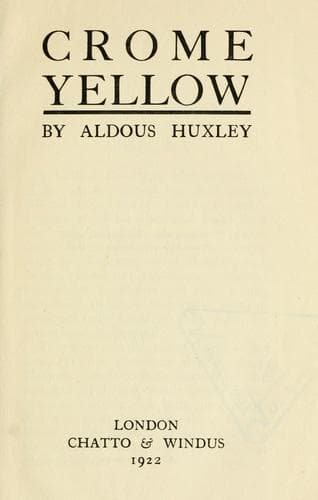
Country homes -- Fiction; England -- Fiction; Humorous stories; Intellectuals -- Fiction; Satire
After painting for a little time in silence Gombauld began to speak
again. “And then there’s Denis,” he said, renewing the conversation as
though it had only just been broken off. “You’re playing the same game
with him. Why can’t you leave that wretched young man in peace?”
Anne flushed with a sudden and uncontrollable anger. “It’s perfectly
untrue about Denis,” she said indignantly. “I never dreamt of playing
what you beautifully call the same game with him.” Recovering her calm,
she added in her ordinary cooing voice and with her exacerbating smile,
“You’ve become very protective towards poor Denis all of a sudden.”
“I have,” Gombauld replied, with a gravity that was somehow a little too
solemn. “I don’t like to see a young man...”
“...being whirled along the road to ruin,” said Anne, continuing his
sentence for him. “I admire your sentiments and, believe me, I share
them.”
She was curiously irritated at what Gombauld had said about Denis. It
happened to be so completely untrue. Gombauld might have some slight
ground for his reproaches. But Denis--no, she had never flirted with
Denis. Poor boy! He was very sweet. She became somewhat pensive.
Gombauld painted on with fury. The restlessness of an unsatisfied
desire, which, before, had distracted his mind, making work impossible,
seemed now to have converted itself into a kind of feverish energy. When
it was finished, he told himself, the portrait would be diabolic. He was
painting her in the pose she had naturally adopted at the first sitting.
Seated sideways, her elbow on the back of the chair, her head and
shoulders turned at an angle from the rest of her body, towards the
front, she had fallen into an attitude of indolent abandonment. He had
emphasised the lazy curves of her body; the lines sagged as they crossed
the canvas, the grace of the painted figure seemed to be melting into
a kind of soft decay. The hand that lay along the knee was as limp as
a glove. He was at work on the face now; it had begun to emerge on the
canvas, doll-like in its regularity and listlessness. It was Anne’s
face--but her face as it would be, utterly unillumined by the inward
lights of thought and emotion. It was the lazy, expressionless mask
which was sometimes her face. The portrait was terribly like; and at the
same time it was the most malicious of lies. Yes, it would be diabolic
when it was finished, Gombauld decided; he wondered what she would think
of it.
CHAPTER XXII.
Public-domain text, read in full here on John Shaqi.
Reviews
Reviews
No reviews yet
Be the first to share your thoughts on this work.
Elsewhere in the archive
Join the Discussion
Join the discussion
Sign in to leave a comment or review.
Sign InorCreate an account