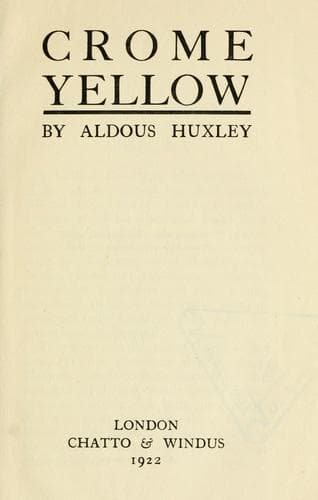
Country homes -- Fiction; England -- Fiction; Humorous stories; Intellectuals -- Fiction; Satire
Denis made no response; he was thinking of other things. “After all,”
he said to himself--“after all, Gombauld is better looking than I, more
entertaining, more confident; and, besides, he’s already somebody and
I’m still only potential...”
“Everything that ever gets done in this world is done by madmen,” Mr.
Scogan went on. Denis tried not to listen, but the tireless insistence
of Mr. Scogan’s discourse gradually compelled his attention. “Men such
as I am, such as you may possibly become, have never achieved anything.
We’re too sane; we’re merely reasonable. We lack the human touch, the
compelling enthusiastic mania. People are quite ready to listen to the
philosophers for a little amusement, just as they would listen to a
fiddler or a mountebank. But as to acting on the advice of the men of
reason--never. Wherever the choice has had to be made between the man of
reason and the madman, the world has unhesitatingly followed the madman.
For the madman appeals to what is fundamental, to passion and
the instincts; the philosophers to what is superficial and
supererogatory--reason.”
They entered the garden; at the head of one of the alleys stood a green
wooden bench, embayed in the midst of a fragrant continent of lavender
bushes. It was here, though the place was shadeless and one breathed
hot, dry perfume instead of air--it was here that Mr. Scogan elected to
sit. He thrived on untempered sunlight.
“Consider, for example, the case of Luther and Erasmus.” He took out
his pipe and began to fill it as he talked. “There was Erasmus, a man
of reason if ever there was one. People listened to him at first--a
new virtuoso performing on that elegant and resourceful instrument, the
intellect; they even admired and venerated him. But did he move them to
behave as he wanted them to behave--reasonably, decently, or at least a
little less porkishly than usual? He did not. And then Luther appears,
violent, passionate, a madman insanely convinced about matters in which
there can be no conviction. He shouted, and men rushed to follow
him. Erasmus was no longer listened to; he was reviled for his
reasonableness. Luther was serious, Luther was reality--like the Great
War. Erasmus was only reason and decency; he lacked the power, being a
sage, to move men to action. Europe followed Luther and embarked on
a century and a half of war and bloody persecution. It’s a melancholy
story.” Mr. Scogan lighted a match. In the intense light the flame was
all but invisible. The smell of burning tobacco began to mingle with the
sweetly acrid smell of the lavender.
Public-domain text, read in full here on John Shaqi.
Reviews
Reviews
No reviews yet
Be the first to share your thoughts on this work.
Elsewhere in the archive
Join the Discussion
Join the discussion
Sign in to leave a comment or review.
Sign InorCreate an account