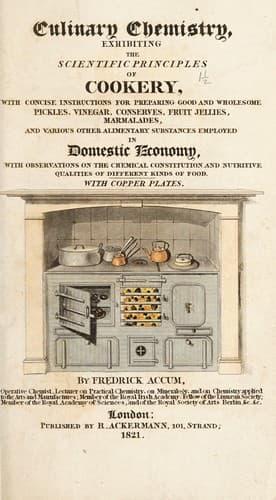
Culinary Chemistry: The Scientific Principles of Cookery, with Concise Instructions for Preparing Good and Wholesome Pickles, Vinegar, Conserves, Fruit Jellies, Marmalades, and Various Other Alimentary Substances Employed in Domestic Economy, with Observations on the Chemical Constitution and Nutritive Qualities of Different Kinds of Food. — John Shaqi
Culinary Chemistry: The Scientific Principles of Cookery, with Concise Instructions for Preparing Good and Wholesome Pickles, Vinegar, Conserves, Fruit Jellies, Marmalades, and Various Other Alimentary Substances Employed in Domestic Economy, with Observations on the Chemical Constitution and Nutritive Qualities of Different Kinds of Food.Accum, Friedrich Christian
Science
Culinary Chemistry: The Scientific Principles of Cookery, with Concise Instructions for Preparing Good and Wholesome Pickles, Vinegar, Conserves, Fruit Jellies, Marmalades, and Various Other Alimentary Substances Employed in Domestic Economy, with Observations on the Chemical Constitution and Nutritive Qualities of Different Kinds of Food.
Accum, Friedrich Christian
Cooking; Food poisoning
The melted fat, or oil, should always be brought to the boiling point,
or nearly so. The proper temperature is ascertained by putting into the
fat a few sprigs of parsley, a thin slice of turnip, or a piece of
bread, and if any of these substances become crisp without acquiring a
black colour, the fat is hot enough for frying; if it be made hotter,
it becomes blackened, and the meat acquires a burnt and unpleasant
flavour. Any sort of hard fat, such as beef suet, is the best fitted for
frying meat; because, fat of this description can be brought to a higher
temperature, without suffering decomposition, than either lard, butter,
or oil. There are, however, particular kinds of meat which answer better
with some one or other of these than with any of the rest. Fish, for
example, is best fried in oil.
A rich brown colour is communicated to the fried substance, by pressing
it, when nearly cooked, against the bottom of the pan.
The fire for frying should be kept sharp and clear, to keep the melted
fat at a sufficient high temperature, and without this precaution the
fried substance cannot be browned. If the temperature of the fat is not
hot enough, the fried meat will be sodden. Fish cannot be fried of a
good colour, and crisp, and firm texture, unless the fat is boiling hot.
Frying, though one of the most common culinary occupations, is one of
those that is least commonly performed.
Eggs are often fryed.
“Fresh butter, hissing in the pan, receives the yolk and white together
in its burning bosom. One minute or two and all the noise is over; and,
sprinkled with pepper, salt, and a few drops of vinegar, they appear
perfectly fit for the table. The _salamander_ is often held over them,
and accelerates the culinary process.”
_Rationale._--The process of frying is considerably different from those
which we have formerly been examining. In frying, the high temperature
of the melted fat has the effect of extracting (at least from the outer
surface) all the gelatine, osmazome and albumen, the place of which is,
in part, supplied by the melted fat entering between the fibres, and
gradually filling up the interstices. It is this circumstance which
prevents the fibres of fried meat from becoming hard and dry, and
preserves them in a tender and supple state. Meat which has been fried,
shrinks more in bulk than when boiled or roasted, in consequence of the
melted fat having a stronger influence in dislodging the animal juices.
It is this also which gives the meat the structure which has not unaptly
been compared to leather.
Taste informs us, independently of our _rationale_, that fried meat is
less gelatinous and less savoury than when simply boiled or roasted. It
is also less tender. The gelatine and other juices of the animal fibre,
which are extracted during the process may be discovered, after the
melted matter in the pan is suffered to settle, in the form of a rich,
brown, savoury jelly, which separates spontaneously from the rest of the
substance.
Public-domain text, read in full here on John Shaqi.
Reviews
Reviews
No reviews yet
Be the first to share your thoughts on this work.
Join the Discussion
Join the discussion
Sign in to leave a comment or review.
Sign InorCreate an account