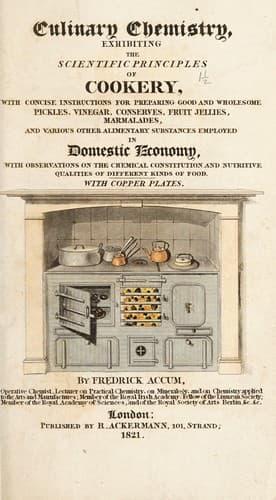
Culinary Chemistry: The Scientific Principles of Cookery, with Concise Instructions for Preparing Good and Wholesome Pickles, Vinegar, Conserves, Fruit Jellies, Marmalades, and Various Other Alimentary Substances Employed in Domestic Economy, with Observations on the Chemical Constitution and Nutritive Qualities of Different Kinds of Food.Accum, Friedrich Christian
Science
Culinary Chemistry: The Scientific Principles of Cookery, with Concise Instructions for Preparing Good and Wholesome Pickles, Vinegar, Conserves, Fruit Jellies, Marmalades, and Various Other Alimentary Substances Employed in Domestic Economy, with Observations on the Chemical Constitution and Nutritive Qualities of Different Kinds of Food.
Accum, Friedrich Christian
Cooking; Food poisoning
The paste for a meat pudding is usually made with beef suet, or marrow,
one part of it chopped as fine as possible, and intimately mixed with
four parts by weight of flour, is made into a paste with water or milk.
With this paste, a pudding mould or basin, previously rubbed with butter
within, is lined, and the meat is added to fill up the vacancy. A lid of
paste is now put over the meat, and made to adhere to the margin of the
dish. The whole is then tied over with a wetted cloth, dusted with
flour to prevent the dough sticking to it, and then boiled in water till
the pudding is sufficiently cooked.
The other kind of pudding is a batter composed of eggs, butter and
flour, or any other farinaceous substance, occasionally enriched with
the admixture of fruit, sugar, and spices, and rendered eatable either
by boiling in the manner stated, or by baking in an oven.
MADE DISHES,
So called to distinguish them from plain, roasted, boiled, or fried
meat; are usually composed of flesh, fish, poultry, or vegetables,
stewed with gravy, butter, cream, or other savoury sauces. The
composition of made dishes is generally from printed or written
receipts, except when done by what are termed professed cooks, who,
understanding completely their business, follow their own judgment, in
aid of the receipt. There is a mistake very common in supposing that
there is a great difficulty in cooking such dishes, though there is
indeed much trouble; but if a mistake is made, it can in general be
remedied, which is not the case in the mere simple operations of
roasting and boiling, where a mistake is very often irreparable.
When we take a view of the chemical composition of made dishes, we soon
perceive that they are all compounds of animal and vegetable substances,
rendered sapid or agreeable to the palate by strong decoctions of meat,
gravy, and spices, of various descriptions; all of them abound in
animal gelatine and vegetable mucilage, or farinaceous matter, rendered
soluble in water. The quantity of spices is generally small, “[29]their
presence should be rather supposed than perceived, they are the
invisible spirit of good cookery.”
[29] Dr. Kitchiner’s Cook’s Oracle, p. 493.
OBSERVATIONS ON MADE DISHES.
Public-domain text, read in full here on John Shaqi.
Reviews
Reviews
No reviews yet
Be the first to share your thoughts on this work.
Elsewhere in the archive
Join the Discussion
Join the discussion
Sign in to leave a comment or review.
Sign InorCreate an account