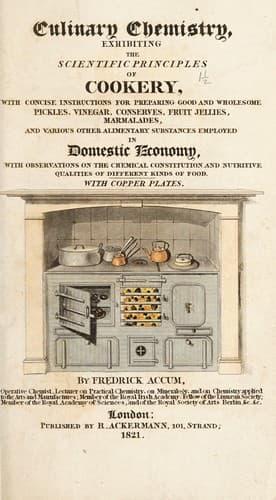
Culinary Chemistry: The Scientific Principles of Cookery, with Concise Instructions for Preparing Good and Wholesome Pickles, Vinegar, Conserves, Fruit Jellies, Marmalades, and Various Other Alimentary Substances Employed in Domestic Economy, with Observations on the Chemical Constitution and Nutritive Qualities of Different Kinds of Food.Accum, Friedrich Christian
Science
Culinary Chemistry: The Scientific Principles of Cookery, with Concise Instructions for Preparing Good and Wholesome Pickles, Vinegar, Conserves, Fruit Jellies, Marmalades, and Various Other Alimentary Substances Employed in Domestic Economy, with Observations on the Chemical Constitution and Nutritive Qualities of Different Kinds of Food.
Accum, Friedrich Christian
Cooking; Food poisoning
The flour is made into a stiff paste with cold water, and rolled out on
a board with a paste pin to the thickness of about one quarter of an
inch, the board being previously sprinkled over with flour to prevent
the dough from sticking to the board. About one-sixth part of the
butter, in pieces of the size of a nutmeg, is put over the extended
paste, and the whole again dusted with flour; the paste is then doubled
up and rolled out as before. A like portion of butter is again
distributed over the paste, which, after being doubled up, is rolled
out, and the same operation is repeated till the whole quantity of
butter is thus incorporated with the flour.
Part of the paste is then laid, one quarter or half an inch in
thickness, over the inside of a deep dish in which the pie is to be
baked, and the meat, cut in chops or slices, is put into the dish,
together with the seasonings, and a portion of water or gravy, about one
tea cup full, to one pound of meat. The contents of the basin are then
covered with a lid, made of the remainder of the paste, rolled out
rather thicker than the inside lining of the dish, and the lid is made
to adhere to the inside sheeting, which should extend over the rim of
the dish, by pressing the top paste close upon the margin. A few small
holes are then made in the top crust, and the pie is put in the oven.
The baking should be slow. If the pie be put into a hot oven, the crust
becomes hard, and many a cook is blamed for making bad pies, when the
fault really lies with the baker. A light and flaky pie crust can only
be produced by the judicious application in the manner stated, of the
butter, or fatty matter. By this means the butter is distributed, in
distinct layers, through the mass of the pie crust. The flour dusted
over each layer prevents the paste forming one mass, or, as it is
called, becoming heavy. The more frequently, therefore, the paste is
rolled out with butter, lard, or other fat, interposed between each
layer, provided the layers are dusted over with flour, the more flaky
will be the pie; and hence, also, by increasing the quantity of butter,
to a certain limit, the flakeness of the pie crust becomes increased.
Pastry cooks usually allow from ten to twelve ounces of butter to one
pound of flour for making a light puff paste, such as they use for tarts
and patties.
PUDDINGS
Are of two kinds; the first consists of a farinaceous dough, containing
a portion of butter or other fat, inclosing any kind of meat or fruit,
and rendered eatable by boiling; it may be termed _a boiled pie_.
Public-domain text, read in full here on John Shaqi.
Reviews
Reviews
No reviews yet
Be the first to share your thoughts on this work.
Elsewhere in the archive
Join the Discussion
Join the discussion
Sign in to leave a comment or review.
Sign InorCreate an account