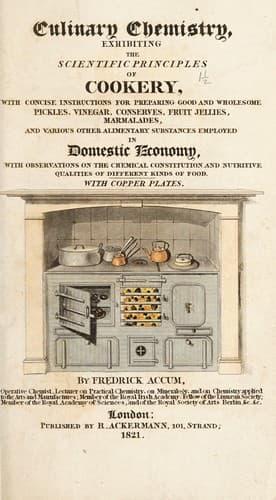
Culinary Chemistry: The Scientific Principles of Cookery, with Concise Instructions for Preparing Good and Wholesome Pickles, Vinegar, Conserves, Fruit Jellies, Marmalades, and Various Other Alimentary Substances Employed in Domestic Economy, with Observations on the Chemical Constitution and Nutritive Qualities of Different Kinds of Food.Accum, Friedrich Christian
Science
Culinary Chemistry: The Scientific Principles of Cookery, with Concise Instructions for Preparing Good and Wholesome Pickles, Vinegar, Conserves, Fruit Jellies, Marmalades, and Various Other Alimentary Substances Employed in Domestic Economy, with Observations on the Chemical Constitution and Nutritive Qualities of Different Kinds of Food.
Accum, Friedrich Christian
Cooking; Food poisoning
Melted butter is the grand and chief basis of most English sauces.
Melted butter and oysters, melted butter and parsley, melted butter and
anchovies, melted butter and eggs, melted butter and shrimps, melted
butter and lobsters, melted butter and capers, are nearly all the sauces
used in England. Besides these, the following flavouring substances are
in common use: _viz._ mushrooms, onions, spices, sweet herbs, wine, soy,
and the usual condiments, but melted butter, gravy, or some farinaceous
mucilage, form the basis of all sauces. These substances combined in
different proportions are quite sufficient to make an endless variety of
picquant sauces, as pleasant to the palate and stomach, as the most
compound foreign sauces in which every thing has the same taste, and
none its own taste. The aim of the English cooks, as far as it regards
sauces, appears to be to let every sauce display a decided character,
so as to taste only of the material from which it derives its name.
_Compound sauces_ are seldom employed, but in the _learned_ foreign
dishes.
What has been observed, relative to time used in the article, of _made
dishes_, namely, that it was in this country too valuable to be bestowed
on eating, or on preparing to eat, applies also in the case of making
sauces.
Nothing can be made more easily than the English sauces, but the variety
of French sauces are great, and much skill and time are necessary for
preparing most of them.
THICKENING PASTE FOR BROTH, SOUP, GRAVY, AND MADE DISHES.
It is customary to thicken some dishes with a compound of two parts of
flour and one of butter, first made into a paste by heating slowly the
ingredients in a pan, till the mass acquires a yellow gold colour, the
flour and butter being stirred all the time to prevent the mass from
burning to the bottom of the pan. The substance thus obtained is called
_thickening_, or _thickening paste_, for it is the basis employed by
cooks for thickening soups, gravies, stews, sauces, and other dishes.
The mass readily combines with water; a large table spoonful is
sufficient to thicken a quart of meat broth. Besides this _thickening
paste_, other farinaceous substances are employed for that purpose,
such as bread raspings, crumbs of stale bread, biscuit powder, potatoe
mucilage, oatmeal, sago powder, rice powder, &c. A cow-heel, on account
of the vast quantity of gelatine with which it abounds, is excellently
well calculated for giving _body_ to soups: the cow-heel, after being
cracked, is boiled with the broth or soup.
COLOURING FOR BROTH, SOUP, GRAVIES, AND MADE DISHES.
Public-domain text, read in full here on John Shaqi.
Reviews
Reviews
No reviews yet
Be the first to share your thoughts on this work.
Elsewhere in the archive
Join the Discussion
Join the discussion
Sign in to leave a comment or review.
Sign InorCreate an account