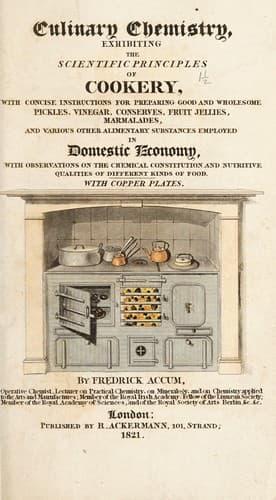
Culinary Chemistry: The Scientific Principles of Cookery, with Concise Instructions for Preparing Good and Wholesome Pickles, Vinegar, Conserves, Fruit Jellies, Marmalades, and Various Other Alimentary Substances Employed in Domestic Economy, with Observations on the Chemical Constitution and Nutritive Qualities of Different Kinds of Food.Accum, Friedrich Christian
Science
Culinary Chemistry: The Scientific Principles of Cookery, with Concise Instructions for Preparing Good and Wholesome Pickles, Vinegar, Conserves, Fruit Jellies, Marmalades, and Various Other Alimentary Substances Employed in Domestic Economy, with Observations on the Chemical Constitution and Nutritive Qualities of Different Kinds of Food.
Accum, Friedrich Christian
Cooking; Food poisoning
The substance employed for colouring soups, gravies, broths, and other
dishes, requiring a brown colour, is burnt sugar. This imparts to the
dish a fine yellowish brown tinge, without giving any sensible flavour
to the dish. Eight ounces of powdered lump sugar, and two or three table
spoonfuls of water, are suffered to boil gently in an iron pan, till the
mass has assumed a dark brown colour, which takes place when all the
water is evaporated, and the sugar begins to be partly charred by the
action of the heat. The mass is then removed from the fire, and about a
quarter of a pint of water is gradually added to effect a solution. The
fluid thus obtained is of a syrupy consistence, and of a fine dark brown
colour; a small quantity gives to broth, soup, or gravy, a bright orange
colour, without altering sensibly the flavour of the dish. Some cooks
add to it mushroom catsup and port wine.
STOCK FOR MAKING EXTEMPORANEOUS BROTH, SOUP, OR GRAVY.
The name of _stock_ is given to meat jelly produced from a decoction of
meat, so highly concentrated that the fluid, when cold, exhibits an
elastic tremulous consistence.
The meat is slowly boiled in water, with the customary seasonings, as
pot herbs, or esculent roots, and the decoction skimmed, and continued
to simmer till it is charged with a sufficient quantity of animal matter
to form a jelly when cold; this degree of concentration is known by
removing, from time to time, a portion of the fluid, and suffering it to
cool. When the decoction has been so far concentrated, it is strained
off through a sieve and suffered to repose, that the insoluble part, if
any, may subside. When this has been effected, the clear fluid is
suffered to cool, which causes the fatty matter it contains to become
collected at the surface, where it forms a cake or crust, which is to be
removed. The substance underneath is a tremulous jelly; it is called
first stock, or long broth, (_Le grand bouillon_ of the French kitchen).
If the jelly be not transparent it is re-melted by a gentle heat, and
clarified by the addition of the white of eggs added to it, as soon as
it is liquified. This substance becoming coagulated at the boiling
heat, entangles with it the parts mechanically diffused through the
jelly, and rises to the top as a dense scum. It may then be removed by a
skimmer. The name of _second-stock_ (_Jus de bœuf_ of the French) is
given to a more concentrate jelly of meat made in a similar manner. It
is chiefly employed as the basis of all savoury made dishes and rich
sauces, whilst the former serves for making extemporaneous soups.
_Second stock_ is usually prepared in the following manner:--Put into a
stew-pan about half a pound of lean bacon or ham, a few carrots and
onions, two or three cloves, about six or eight pounds of lean beef, and
a shin of beef of about the same weight, break the bone, and having
scored the meat, suffer it to simmer over a very gentle fire, with
Public-domain text, read in full here on John Shaqi.
Reviews
Reviews
No reviews yet
Be the first to share your thoughts on this work.
Elsewhere in the archive
Join the Discussion
Join the discussion
Sign in to leave a comment or review.
Sign InorCreate an account