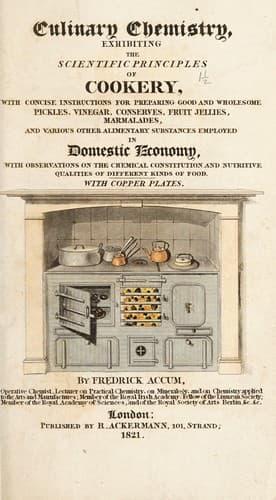
Culinary Chemistry: The Scientific Principles of Cookery, with Concise Instructions for Preparing Good and Wholesome Pickles, Vinegar, Conserves, Fruit Jellies, Marmalades, and Various Other Alimentary Substances Employed in Domestic Economy, with Observations on the Chemical Constitution and Nutritive Qualities of Different Kinds of Food.Accum, Friedrich Christian
Science
Culinary Chemistry: The Scientific Principles of Cookery, with Concise Instructions for Preparing Good and Wholesome Pickles, Vinegar, Conserves, Fruit Jellies, Marmalades, and Various Other Alimentary Substances Employed in Domestic Economy, with Observations on the Chemical Constitution and Nutritive Qualities of Different Kinds of Food.
Accum, Friedrich Christian
Cooking; Food poisoning
_Veal._--The flesh of a bull calf is firmer, but not in general so white
as that of a cow calf. Exposures to the air for some time reddens the
colour of the flesh. Veal is best of which the kidney is well covered
with thick white hard fat.
_Mutton._--A _wether_, five years old, affords the most delicate meat.
The grain of the meat should be fine, and the fat white and firm. The
leg of a _wether mutton_ is known by a round lump of fat on the insides
of the thigh, the leg of an _ewe_ by the udder.
_Lamb._--The flesh of fine lamb looks of a delicate pale red colour; the
fat is splendid white, but it does not possess a great solidity. _Grass
Lamb_ is in season from Easter to Michaelmas. _House Lamb_ from
Christmas to Lady-day.
_Pork._--This species of meat of the best fed animals is particularly
fine grained, and may be bruised by forcibly pressing it between the
fingers. The skin of the young animal is thin; the flesh of old pigs is
hard and tough, and the skin very thick. The prime season for pork is
from Michaelmas to March. The western pigs, chiefly those of Berks,
Oxford, and Bucks, possess a decided superiority over the eastern of
Essex, Suffolk, and Norfolk.
_Hare._--To ascertain its age, examine the first joint of the fore foot;
you will find a small knob, if it is a _leveret_, which disappears as
the hare grows older; then examine the ears; if they tear easily, the
animal is young. When newly killed, the body is stiff; as it grows
stale, it becomes flaccid.
_Venison_--is of a darker colour than mutton. If the fat be clear,
bright and thick, and the cleft of the hoof smooth and close, it is
young, but if the cleft is wide and tough, it is old. By pushing a
skewer or knife under the bone which sticks out of a haunch or shoulder,
the odour of the skewer will tell whether the meat be fresh or tainted.
Venison is best flavoured in the month of August, the animal should not
be killed till he is about four years old.
_Fowls_--for boiling should be chosen as white as possible, those which
have black legs had better be roasted. The season of perfection in
poultry is just before they have quite come to their full growth.
Chickens three months old are very delicate. Age makes a striking
difference in the flesh of fowls, since after the age of twelve months
it becomes tougher. The cock indeed, at that age, is only used for
making soup.
_Pigeons_--are in their greatest perfection in September, there is then
the most plentiful and best food for them; their finest growth is just
when they are full feathered. When they are in the pen-feathers, they
are flabby; when they are full grown, and have flown some time, they are
hard.
_Pheasants_--may be distinguished by the _length_ and _sharpness_ of
their _spurs_, which in the younger ones are _short_ and _blunt_.
Public-domain text, read in full here on John Shaqi.
Reviews
Reviews
No reviews yet
Be the first to share your thoughts on this work.
Elsewhere in the archive
Join the Discussion
Join the discussion
Sign in to leave a comment or review.
Sign InorCreate an account