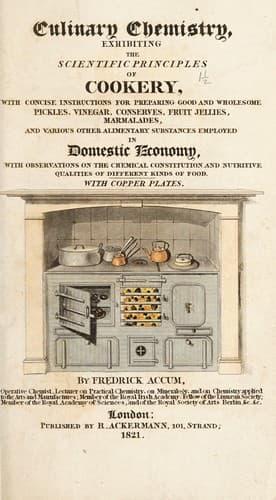
Culinary Chemistry: The Scientific Principles of Cookery, with Concise Instructions for Preparing Good and Wholesome Pickles, Vinegar, Conserves, Fruit Jellies, Marmalades, and Various Other Alimentary Substances Employed in Domestic Economy, with Observations on the Chemical Constitution and Nutritive Qualities of Different Kinds of Food.Accum, Friedrich Christian
Science
Culinary Chemistry: The Scientific Principles of Cookery, with Concise Instructions for Preparing Good and Wholesome Pickles, Vinegar, Conserves, Fruit Jellies, Marmalades, and Various Other Alimentary Substances Employed in Domestic Economy, with Observations on the Chemical Constitution and Nutritive Qualities of Different Kinds of Food.
Accum, Friedrich Christian
Cooking; Food poisoning
There is annually held at St. Petersburg and Moscow what is called the
frozen, or winter market, for the sale of provisions solidified by
frost. In a vast open square, the bodies of many thousand animals are
seen on all sides, piled in pyramidal and quadrangular masses: fish,
fowl, butter, eggs, hogs, sheep, deer, oxen, all rendered solid by
frost. The different species of fish are strikingly beautiful; they
possess the lustre and brilliancy of colour which characterises the
different species in a living state.
Most of the larger kinds of quadrupeds are skinned, and classed
according to their species; groups of many hundreds are piled upon their
hind-legs, one against another, as if each were making an effort to
climb over the back of his neighbour. The motionless, yet apparent
animation of their seemingly struggling attitudes (as if they had died a
sudden death), gives a horrid life to this singular scene of death. The
solidity of the frozen creatures, is such, that the natives chop and saw
them up, for the accommodation of the purchasers, like wood. These
frozen provisions are the produce of countries very remote from each
other. Siberia, Archangel, and still more distant provinces, furnish the
merchandize which, during the severity of the frost, is conveyed hither
on sledges.
In consequence of the multitude of these commodities, and the short
period allowed to the existence of the market, they are cheaper than at
any other time of the year, and are, therefore, purchased in larger
quantities, to be stored, as a winter stock.
When disposed in cellars, they will keep, with care, for a considerable
time during the cold season. All the provisions which remain, and are
exposed to the temperate atmosphere, speedily putrify; but as the
desertion of the frost is generally pretty well calculated, almost to a
day, but little loss is suffered in this respect. The same advantage is
taken of the cold in Canada, and all other countries, when the frost is
sufficiently steady.
Substances, so long as they are hard frozen, probably undergo no
chemical change, of which the most striking proof was afforded by the
body of an animal, probably antediluvian, being found imbedded in a mass
of ice at the mouth of the Lena; but in the act of freezing, or of the
subsequent thawing, some alteration is produced, which affects the
nature of the substance. This may be either merely mechanical, from the
particles of ice during their formation, tearing asunder and separating
the fibres, or chemical, by destroying the intimate union of the
constituents of the fluids, as in wine injured by having been frozen; or
by causing new combinations, of which we have an example in the
sweetness acquired by the potatoe.
Public-domain text, read in full here on John Shaqi.
Reviews
Reviews
No reviews yet
Be the first to share your thoughts on this work.
Elsewhere in the archive
Join the Discussion
Join the discussion
Sign in to leave a comment or review.
Sign InorCreate an account