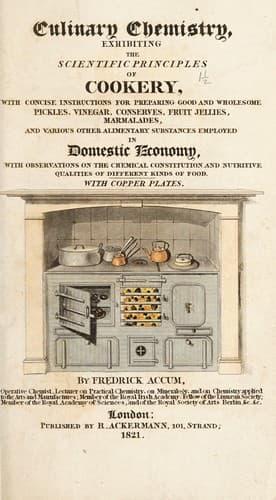
Culinary Chemistry: The Scientific Principles of Cookery, with Concise Instructions for Preparing Good and Wholesome Pickles, Vinegar, Conserves, Fruit Jellies, Marmalades, and Various Other Alimentary Substances Employed in Domestic Economy, with Observations on the Chemical Constitution and Nutritive Qualities of Different Kinds of Food.Accum, Friedrich Christian
Science
Culinary Chemistry: The Scientific Principles of Cookery, with Concise Instructions for Preparing Good and Wholesome Pickles, Vinegar, Conserves, Fruit Jellies, Marmalades, and Various Other Alimentary Substances Employed in Domestic Economy, with Observations on the Chemical Constitution and Nutritive Qualities of Different Kinds of Food.
Accum, Friedrich Christian
Cooking; Food poisoning
Some attention is necessary for thawing provisions which have been
frozen. “When used, the beef cannot be divided but by an axe or saw; the
latter instrument is preferred. It is then put into cold water, from
which it derives heat by the formation of ice around it, and soon thaws;
but if put into hot water, much of the gravy is extracted, and the meat
is injured without being thawed more readily. If an attempt be made to
cook it before it is thawed, it may be burnt on the outside, while the
centre remains raw, or actually in a frozen state.” These observations,
which we have transcribed from Captain Scoresby, an excellent observer,
agree with the directions of earlier writers. Thus Krünitz says,[35]
“when fish taken under the ice are frozen, lay them in cold water, which
thus draws the ice out of the fish, so that it can be scraped off their
scales. They taste much better afterwards than when they are allowed to
thaw in a warm room.”
[35] Encyclop. Vol. X. p. 586.
Pickles.
The antiseptic power of vinegar is employed with advantage in domestic
economy for preserving from decay a variety of fruits, roots, leaves,
and other parts of vegetables, which by a species of refinement and
luxury, are often considered as condiments to improve the relish of
several kinds of food. Their qualities, no doubt, depends almost
entirely on the vinegar, spice, or salt imbibed by them.
The art of preparing vinegar pickles consists in impregnating the
vegetable substances with the strongest vinegar, to which are usually
added a portion of common salt, and the most heating spices. To effect
this object, the substance to be pickled is usually suffered to
macerate, or slightly boiled with the acid, and afterwards kept infused
in it, together with spices and salt.
It is customary to impregnate the article to be pickled first in a
strong brine of common salt; but this is not absolutely necessary for
the preservation of the pickled substance. To facilitate the action of
the vinegar or salt, the articles to be pickled, especially such as
walnuts, cucumbers, &c. should be punctured with a large needle or fork.
To assist their preservation, and to improve their flavour, a variety of
pungent and aromatic spices are added, which vary according to the fancy
of the cook; pepper, pimento, cloves, mace, ginger, capsicum, and
mustard, are the spices usually employed.
For the preparation of acid pickles, the vinegar prepared from wood, as
in itself containing no substance liable to a spontaneous decay, is
preferable to common malt vinegar, although the contrary has been
asserted, because it is free from mucilage, which promotes the spoiling
of common vinegar, and therefore the former is a better antiseptic than
vinegar abounding in mucilage. We prepare our home-made pickles with
this acid, and we are authorised to state that, although kept for years,
they are inferior to none met with in commerce.
Public-domain text, read in full here on John Shaqi.
Reviews
Reviews
No reviews yet
Be the first to share your thoughts on this work.
Elsewhere in the archive
Join the Discussion
Join the discussion
Sign in to leave a comment or review.
Sign InorCreate an account