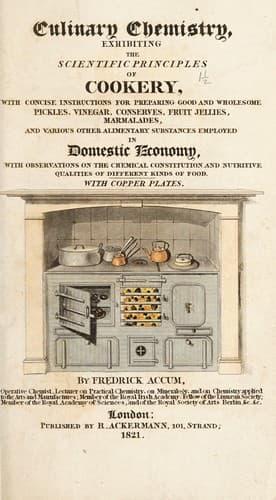
Culinary Chemistry: The Scientific Principles of Cookery, with Concise Instructions for Preparing Good and Wholesome Pickles, Vinegar, Conserves, Fruit Jellies, Marmalades, and Various Other Alimentary Substances Employed in Domestic Economy, with Observations on the Chemical Constitution and Nutritive Qualities of Different Kinds of Food.Accum, Friedrich Christian
Science
Culinary Chemistry: The Scientific Principles of Cookery, with Concise Instructions for Preparing Good and Wholesome Pickles, Vinegar, Conserves, Fruit Jellies, Marmalades, and Various Other Alimentary Substances Employed in Domestic Economy, with Observations on the Chemical Constitution and Nutritive Qualities of Different Kinds of Food.
Accum, Friedrich Christian
Cooking; Food poisoning
If pickled cucumber, or any other kind of vegetable pickle, be wanted of
a lively green colour, it may readily be effected by soaking them when
ready prepared, for a few minutes, first in tincture of turmeric, and
then in a diluted solution of the colouring matter of indigo, dissolved
in water.[37] This method of straining the pickle is perfectly harmless.
[37] This substance is called, at the colour-shops, intense (not
liquid blue, which is quite a different preparation of Indigo,) blue.
Samphire, French beans, tomatoes, capsicum pods, nasturtium and raddish
pods, may be pickled in the same manner.
PICKLED RED BEET-ROOT.
Boil the root till sufficiently done; peel it and cut it into thin
slices. Put it into a stone jar, and pour over it white vinegar,
seasoned with long pepper, horse-raddish, cut into small slices,
allspice, cloves, and salt.
PICKLED MUSHROOMS.
Having peeled small button mushrooms, put them in a strong brine of salt
for three or four days; strain off the brine, and pour over them boiling
hot vinegar: season with long pepper, ginger, and mace.
PICKLED ARTICHOKE.
Take large fresh gathered artichokes, boil and simmer them till they are
nearly tender, remove the leaves and choke, and put the bottom part of
the artichoke in a salt brine for about forty-eight hours; then strain
off the brine, put the artichoke into a jar, and cover it with vinegar,
previously heated to the boiling point, and seasoned with pepper, salt,
eschalots, and mace.
SOUR KRAUT.
M. Parmentier has given a minute description of a process of making sour
kraut on the large scale. The heads of white winter cabbages, after
removing the outer leaves, are to be cut into fine shreds, by means of a
knife, or with a plane, and spread out to dry upon a cloth in the shade.
A cask is to be set on end, with the head taken out. If it formerly
contained vinegar or wine, so much the better, as it will promote the
fermentation, and give the cabbage a more vinous taste; if not, the
inside may be rubbed over with sour kraut liquor. Caraway seeds are to
be mixed with the shreds of cabbage, a good layer of salt is placed at
the bottom of the cask, and then cabbage shreds evenly packed, to the
depth of four or six inches. The layers are regularly stamped down with
a wooden stamper, to half their original bulk. The same process is to be
repeated, with additional layers of salt, and shreds, till the whole be
packed. They are then to be covered with a layer of salt, or till the
barrel be filled within two inches of the top, over which the outside
leaves of the cabbages are to be spread. About two pounds of salt are
required for twenty middling sized cabbages.
Public-domain text, read in full here on John Shaqi.
Reviews
Reviews
No reviews yet
Be the first to share your thoughts on this work.
Elsewhere in the archive
Join the Discussion
Join the discussion
Sign in to leave a comment or review.
Sign InorCreate an account