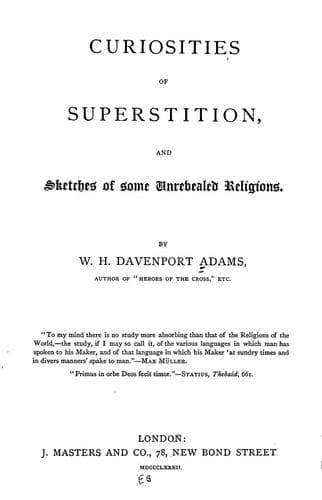
Curiosities of Superstition, and Sketches of Some Unrevealed ReligionsAdams, W. H. Davenport (William Henry Davenport)
Religion
Curiosities of Superstition, and Sketches of Some Unrevealed Religions
Adams, W. H. Davenport (William Henry Davenport)
Folklore; Religions; Superstition
On arriving at a temple in the suburbs, it came to a halt. The gods were
taken out of the sedan-chairs, and with a great exhibition of reverence,
replaced in the temple, from which they had been removed in the morning.
Then their worshippers bent low before their altars, burning incense, and
depositing their gifts. Numerous groups of well-dressed ladies and their
children were scattered over the ground in the neighbourhood of the
temple; all were kneeling, and apparently they conducted their devotions
with great earnestness. A large quantity of paper, in the shape of the
Sycee silver ingots, was piled up on the grass by the different devotees,
and when the ceremonies of the day were being brought to a conclusion, the
whole was burned in honour of, or as an offering to, the gods.
CHAPTER VII.
_AMONG THE MALAYS: THE SLAMATAN BROMOK; THE DYAKS; THE PAPUAN TRIBES; THE
AHETAS._
THE SLAMATAN BROMOK.
A religious ceremony exists in Java which has an obvious affinity to the
old Nature-Worship, and finds its excuse in the dread with which the
uncivilised races regarded the mysterious forces of Nature, unseen in
themselves, but palpable in their results. About three miles from the town
of Tosari, rises the barren cone of the Bromok, a still active volcano,
which is strangely situated in the bosom of green wooded hills and
mountains,--a significant blur upon the landscape. The traveller who
desires to accomplish its ascent climbs up the rough and almost
precipitous slope by a path winding through immense breadths of a tall
yellow grass called the alang-alang. When he has attained to the brink of
the Monegal, an enormous extinct crater, reputed to be the largest in the
world, he will do well to pause, and survey the landscape before him. Of
the knot of mountains on which his eye rests, the foremost is called the
Batok, or Butak, that is, the Bald; in allusion, probably, to its barren
summit, for its sides are well clothed with herbage. It is shaped like a
cone, with deep grooves down its declivities, indicating the course taken
by the lava-streams formerly ejected from its interior. To its right, a
little in the rear, stretches the sharp pointed chain of the Dedari and
Widadarea, or “abode of fairies;” while, on the left, shrouded in smoke
clouds, which partially conceal its bulk, is situated the mass of the
dreary Bromok.
Descending into the crater, we cross its sandy floor, the Dasar,--or, as
it is appropriately called, the Sandy Sea,--where grows not tree nor
shrub, and the only signs of vegetation are a few scattered patches of
dried and scrubby grass. The surface is strangely corrugated or ridged,
like the sea-sand at ebb of tide; and the whole landscape is as full of
gloom as the waste of the African Sahara.
Public-domain text, read in full here on John Shaqi.
Reviews
Reviews
No reviews yet
Be the first to share your thoughts on this work.
Elsewhere in the archive
Join the Discussion
Join the discussion
Sign in to leave a comment or review.
Sign InorCreate an account