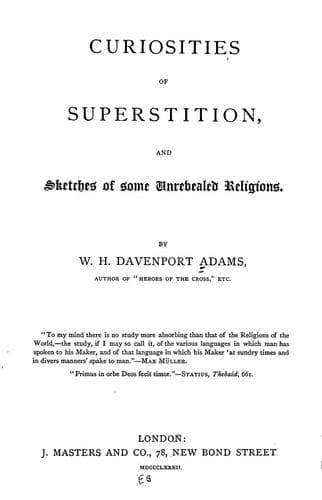
Curiosities of Superstition, and Sketches of Some Unrevealed ReligionsAdams, W. H. Davenport (William Henry Davenport)
Religion
Curiosities of Superstition, and Sketches of Some Unrevealed Religions
Adams, W. H. Davenport (William Henry Davenport)
Folklore; Religions; Superstition
On reaching the summit of the volcano, the various families and
individuals again present their offerings to the priests, who mumble over
them a few additional words: they are then thrown into the crater, each
person eagerly repeating some prayer or wish. And thus concludes the
strange ceremony by which the spirits of the Bromok are supposed to be
propitiated. The crowd descend from the volcano to join in various games
and pastimes; towards evening they begin to disperse, and as the night
spreads its cloud of darkness over the scene, the Sea of Sand resumes its
ordinary aspect of loneliness and desolation.
THE DYAKS OF BORNEO.
It is not certain that the Dyaks possess any religion. Temminck asserts
that they _have_, and that it bears a close resemblance to “fetichism.”
The god Djath, he says, rules the sublunar world, and the god Sangjang
presides over hell. These gods wear the human form, but are invisible; the
Dyaks invoke them by sprinkling rice on the ground, and offering various
sacrifices. In the houses of the Dyaks, adds Temminck, wooden idols are
frequently met with.
Other travellers are of opinion that they profess a kind of Pantheism, and
represent them as believing, like the ancient Greeks, in a multitude of
gods, gods above and gods below the world, as well as innumerable good and
evil spirits, of whom Budjang-Brani is undoubtedly the most wicked. All
diseases are caused by the agency of evil demons, and all misfortunes; and
therefore the Dyaks make vigorous efforts to drive them away by shouts,
and shrieks, and the discordant gong. So in some of the West Indian
islands the natives, during an eclipse, would seek, by a horrible clamour,
to frighten away the monster they supposed to be devouring the moon.
Some authorities go so far as to represent the Dyaks as cherishing vague
ideas of the Unity of the Godhead and the immortality of the soul.
Madame Ida Pfeiffer was by no means a philosophical traveller, but she was
an honest observer; and as the result of her explorations in Borneo, she
positively affirms that among the tribes she visited are neither temples
nor idols, priests nor sacrifices. On the occasions of their births,
marriages and funerals they perform certain ceremonies, but these appear
to be devoid of all religious character. Usually on such occasions they
kill fowls as well as hogs. When concluding treaties of peace they always
slaughter swine, but they do not eat them, and in this custom we may trace
perhaps the propitiatory idea. A few tribes burn their dead, and preserve
the ashes in hollow trees; others inter them in the least accessible
localities, such as the summits of lofty mountains; others bind the corpse
to the trunk of a tree in the position in which S. Peter was crucified,
that is, with the feet upwards and the head downwards.
IN BOURU.
Public-domain text, read in full here on John Shaqi.
Reviews
Reviews
No reviews yet
Be the first to share your thoughts on this work.
Elsewhere in the archive
Join the Discussion
Join the discussion
Sign in to leave a comment or review.
Sign InorCreate an account