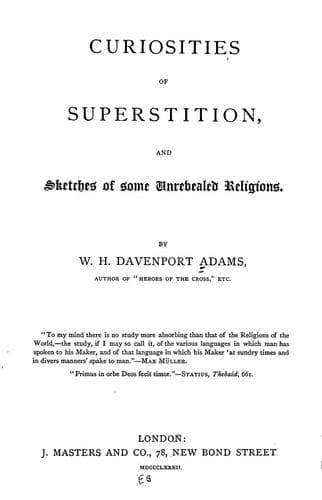
Curiosities of Superstition, and Sketches of Some Unrevealed ReligionsAdams, W. H. Davenport (William Henry Davenport)
Religion
Curiosities of Superstition, and Sketches of Some Unrevealed Religions
Adams, W. H. Davenport (William Henry Davenport)
Folklore; Religions; Superstition
Among the Dorians, or the inhabitants of the north coast of New Guinea,
near Port Dory, an almost childish superstition prevails. Always and
everywhere they carry about with them a variety of charms and talismans,
such as bits of bone, or quartz, or carved wood, to which, for some reason
or other, an artificial value has come to be attached. Those among them
who have acquired a slight knowledge of Mohammedanism use verses of the
Koran written upon narrow strips of paper by the Mohammedan priests of
Ceram and Tidore. But most of the Dorians are pagans, and worship an idol
called “Karwar,” a clumsy figure of which, carved in wood, holding a
shield, and distinguished by an exceptionally large head, with a sharp
nose and a wide mouth, is kept in every house, and plays the part of a
dumb oracle. Its owner, when involved in any difficulty or danger, hastens
to crouch before it, bowing or salaaming repeatedly, with his hands
clasped upon his forehead. If while thus engaged he experiences an emotion
of doubt or despondency, it is considered an evil sign, and he proceeds to
abandon whatever may have been his wish or object. It will thus be seen
that everything depends upon the votary’s temperament or natural
disposition,--if he be a sanguine and resolute man, it is not likely that
he will be conscious of any untoward sensation; and, in such a case, he of
course concludes that he has the sanction of his “Karwar.” In other words,
his will fortifies him to carry out his wishes. But even among civilised
nations a similar method of “consulting the oracle,”--of soliciting the
advice of another with the intention of following it only if it coincides
with one’s own desires,--is sometimes heard of!
The Dorians appear to maintain a priestly caste; but its functions are
confined to the interpretation of dreams and omens; besides which its
members act as “medicine men.” There are no religious rites, no
sacrifices. The two notable events of marriage and death pass with little
show. In the former, the intending bride and bridegroom sit down before
the Karwar, the woman offers the man homage in the shape of tobacco and
betel-leaf; then they join hands, rise up, and are recognised as man and
wife. When a death occurs, the corpse is wrapped in a white calico shroud,
and interred in a pit about five feet deep. There it lies upon its side in
the midst of its weapons and ornaments, and a porcelain dish under its
ear. The grave is afterwards filled up with earth, roofed over with dried
grass, and crowned with the Karwar of the departed.
Public-domain text, read in full here on John Shaqi.
Reviews
Reviews
No reviews yet
Be the first to share your thoughts on this work.
Elsewhere in the archive
Join the Discussion
Join the discussion
Sign in to leave a comment or review.
Sign InorCreate an account