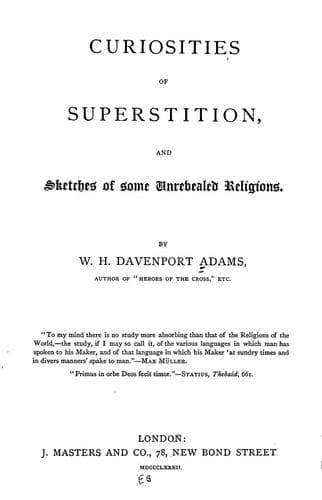
Curiosities of Superstition, and Sketches of Some Unrevealed ReligionsAdams, W. H. Davenport (William Henry Davenport)
Religion
Curiosities of Superstition, and Sketches of Some Unrevealed Religions
Adams, W. H. Davenport (William Henry Davenport)
Folklore; Religions; Superstition
In the foreground an old man is seated in a circular leaf-thatched hut,
with, according to a frequent Indian custom, a scarf bound round his knees
and loins. Behind him in the hut is suspended his upper garment, and in
front a bearded senior, of his own tribe, is, to all appearance,
addressing him. Near this individual stands another pot of fire, with
three pairs of tongs or ladles, and a bundle of sticks to feed the flame.
Close beside him we see one elephant, two buffaloes, sheep, and deer. The
scene takes place in a forest. Above are trees and cocks, with monkeys and
peacocks; below, a reedy marsh opens into a lake blooming with
lotus-flowers and occupied by geese.
A lower bas-relief in the same gateway puts before us a very different
scene:
In the centre of the upper part blooms the sacred Buddhist Tree, behind
its altar, with its Chattee and garlands, occupying a position similar to
that of the serpent in the other bas-relief. Two Garudas or Devas, or
flying figures, present garlands, and two females, instead of griffins,
approach it on either side.
In the lower part of the picture, the Inja, or chief male personage, sits
enthroned upon the Naga, and is sheltered by its five-headed hood. On his
right crouch three women on stools, eating and drinking, and each with her
tutelary or snake behind her; and above them are a female Chaori bearer
and a woman with a bottle--there are snakes behind both. On the other side
are two women playing on drums, two on harps, one on a flute, and a fifth
dancing, but all likewise with snakes, and all in the costume which Mr.
Fergusson defines as that of the Hindus.
The worship of the Naga by the bearded Dasyus as represented in the upper
bas-relief, does not occur again at Sanchi, and occurs only once at
Amravati. There, however, the five-headed snake is seen very frequently in
front of the dagoba, and in a position which is designed to command the
worship, not only of the Dasyus, but of the whole world.
The Hindu male or chief canopied by the Naga, as shown in the lower
bas-relief, occurs at least ten times at Sanchi, and must have occurred
several hundred times at Amravati.
Mr. Fergusson asks, what are we to infer from these facts? Is it that the
Naga, or serpent, was the god of the aborigines, whom the conquering
Hindus adopted as their own deity, and pretended that it was for _them_ he
reserved his patronage and support? We must recollect that the Topes were
built and the sculptures carved by Hindus, and that there is no
representation of a Hindu doing honour to a snake; on the contrary, the
snake always does homage to the Hindu.
Shall we conclude, then, that the Hindus were the real Naga-worshipping
people, and that it was they who enforced serpent-worship on the Dasyus? A
conquered people have not infrequently imposed their language, laws, and
religion on their conquerors.
Public-domain text, read in full here on John Shaqi.
Reviews
Reviews
No reviews yet
Be the first to share your thoughts on this work.
Elsewhere in the archive
Join the Discussion
Join the discussion
Sign in to leave a comment or review.
Sign InorCreate an account