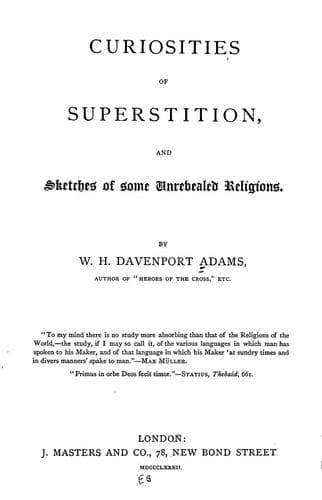
Curiosities of Superstition, and Sketches of Some Unrevealed ReligionsAdams, W. H. Davenport (William Henry Davenport)
Religion
Curiosities of Superstition, and Sketches of Some Unrevealed Religions
Adams, W. H. Davenport (William Henry Davenport)
Folklore; Religions; Superstition
To convince the people of the absurdity of their apprehensions, the
teachers, as soon as the idol was converted into ashes, roasted some
bananas upon them, of which they ate, and invited the spectators to
partake. None however were brave enough to admit so dangerous a morsel
into their mouths, and they waited, open-eyed, for the expected result of
the profane audacity of the two teachers. But, like the inhabitants of
Melita, “after they had looked a great while and saw no harm come to them,
they changed their minds,” and in less than ten days after this event no
fewer than fourteen idols were destroyed. Soon afterwards, the chief
Tinomana sent for the missionaries, and on their arrival at his
mountain-home, informed them that after much deliberation, he had resolved
to become a Christian, and to place himself under their direction. He
therefore wished to know what was the first step he ought to take. They
informed him that he must destroy his maraes and burn his idols; to which
he immediately replied, “Come with me and see them destroyed.” On reaching
the place he desired some person to take a firebrand and set fire to the
temple, the _ataraw_, or altar, and the _unus_, or sacred pieces of carved
wood by which the marae was decorated. Four huge idols were then deposited
at the feet of the teachers, who, having read a portion of the tenth
chapter of S. Luke’s Gospel, which was peculiarly appropriate, especially
from verse 17 to 20, stripped them of their linen wrappings, which they
distributed among the people, and threw them into the flames.
Some of the spectators waxed wroth with the chief, and expressed
themselves with great violence, denouncing him as a fool and a madman for
burning his gods, and listening to worthless fellows who “were drift-wood
from the sea, washed on shore by the waves of the ocean.” The women were
specially vehement in their grief, and broke out into the loudest and
dolefulest lamentations imaginable. Many of them inflicted deep gashes on
their heads with sharp shells and shark’s teeth, and ran wildly to and
fro, smeared with the blood which streamed from their wounds, and crying
in tones of the deepest melancholy, “Alas, alas, the gods of the madman
Tinomana, the gods of the insane chief are given to the flames!” Others,
blackened with charcoal, were not less demonstrative.
In the course of a few days a clean sweep was made of the idols of the
district; never were Iconoclasts, not even our Puritan forefathers, more
thorough or more resolute. The teachers then advised Tinomana and their
other converts to prepare their food for the Sunday, and attend worship at
the mission station. This they did,--but they came armed as for battle,
with war-caps, slings, and spears, fearing lest the irate _Satanus_ (as
they called the idolaters) should attack them. Neither in coming nor
going, however, were they molested.
Public-domain text, read in full here on John Shaqi.
Reviews
Reviews
No reviews yet
Be the first to share your thoughts on this work.
Elsewhere in the archive
Join the Discussion
Join the discussion
Sign in to leave a comment or review.
Sign InorCreate an account