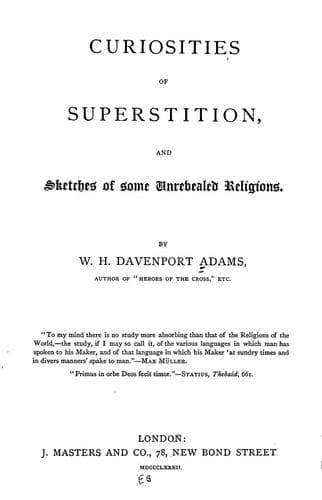
Curiosities of Superstition, and Sketches of Some Unrevealed ReligionsAdams, W. H. Davenport (William Henry Davenport)
Religion
Curiosities of Superstition, and Sketches of Some Unrevealed Religions
Adams, W. H. Davenport (William Henry Davenport)
Folklore; Religions; Superstition
We are speaking however of a barbarous custom which, from whatever cause
it may have arisen, is rapidly dying out. Owing to the constant advance of
the wave of civilisation, and to the vigorous efforts of our missionaries,
the practice of cannibalism, against which our better nature instinctively
rebels, is decaying even in the darkest and remotest regions of the globe.
In Polynesia, for instance, as in New Zealand, it is almost extinct. And
if we owed no other service to the heroic Soldiers of the Cross, this
result would of itself entitle them to our gratitude, the extermination of
Anthropophagy being the first step towards teaching man to reverence
humanity.
CHAPTER XV.
_THE NORTH AMERICAN INDIANS._
The general characteristics of the North American Indians, or the Red Men,
have been made familiar to us through the writings of travellers, and the
picturesque romances of Fenimore Cooper, the American novelist; though of
the latter it may be said, perhaps, that he has used bright colours too
uniformly, and introduced into his sketches too little shadow. The name by
which they are popularly known is, of course, ethnologically incorrect.
Just as, in speaking of the great Western Continent, our forefathers
employed the expression “the West Indies,” or the “Great Indies,” from a
mistaken conception of its geographical position, so they christened by
the term “Indians” all its aboriginal races; and the term has survived in
our common speech owing to its convenience.
Says De Maury: From the North Pole to Tierra del Fuego almost every shade
of human colouring, from black to yellow, finds its representatives.
According to their tribe, the Aborigines are of a brown-olive, a dark
brown, bronze, pale yellow, copper yellow, red, brown, and so on. Nor do
they differ less in stature. Between the dwarf-like proportions of the
Changos, and the tall stature of the Patagonians, we meet with a great
number of intermediary “sizes.” The contours of the body present the same
diversity. Some peoples, like those of the Pampas, are very long in the
bust; others, like the inhabitants of the Peruvian Andes, are short and
broad. So, too, with the shape and size of the head. Yet we recognize
between the various American populations an air of kinship, or certain
predominant and general features which distinguish them from the races of
the old world. As, for example, the pyramidal form of the head and the
narrowness of the forehead, characteristics of great antiquity among the
American populations, having been found in skulls discovered by Mr. Lund
in the caves of Brazil, in association with the bones of animals now
extinct.
Public-domain text, read in full here on John Shaqi.
Reviews
Reviews
No reviews yet
Be the first to share your thoughts on this work.
Elsewhere in the archive
Join the Discussion
Join the discussion
Sign in to leave a comment or review.
Sign InorCreate an account