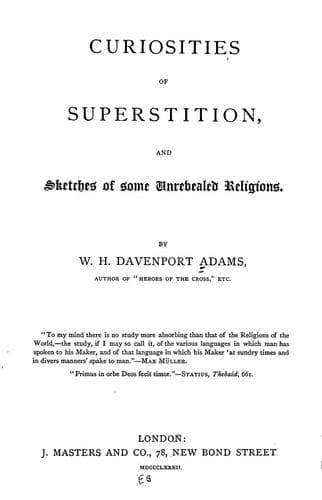
Curiosities of Superstition, and Sketches of Some Unrevealed ReligionsAdams, W. H. Davenport (William Henry Davenport)
Religion
Curiosities of Superstition, and Sketches of Some Unrevealed Religions
Adams, W. H. Davenport (William Henry Davenport)
Folklore; Religions; Superstition
The treatment of the Indians is a dark chapter in the history of the
United States. The great nations which were formerly the valued allies or
dreaded enemies of the European settlers, the Hurons, the Algonquins, the
Iroquois, the Natchez, the Leni-Lenapes, have entirely disappeared. The
wrecks of other but less important tribes still linger on the shores of
the great Northern lakes, in the woods and wildernesses of the Far West,
at the base of the Rocky Mountains, in Texas, in Arkansas, in California,
and in the northern provinces and deserts of Mexico. Such are the Sioux,
the Dacotahs, the Flatheads, the Big-Bellies, the Blackfoot, the Apaches,
the Comanches. The two latter people have been the most successful in
preserving their vitality. Their characteristics however are very diverse.
The Comanches are of a mild gentle nature, and eager to live on peaceable
terms with the whites. The Apaches, on the other hand, have vowed a
relentless hatred against the Pale Faces; they are the terror of the
_hacienderos_ (or farm proprietors) and gold seekers of Upper Mexico, and
the American journals to this day are full of their incursions, and their
acts of cruelty and brigandage.
Physiologically, the distinctive features of the Red Men are, in addition
to the colour of their skin and the pyramidal form of the head, the
prominency and arched outline of the nose, the width of the nasal
apertures, corresponding to a remarkable development of the olfactory
nerve, and the absence of beard.
The superstitions, or religious customs, of the Red Men are in themselves
a sufficiently interesting subject of study. We begin with an account of
the ceremony through which every one of their youths has to pass before he
is acknowledged to have entered upon manhood. Our knowledge of it is due
to Mr. Catlin, who, as a reputed “medicine-man,” lived for some time with
the Mandan tribe, and became acquainted with their most secret customs.
The object of this rite, which for savage cruelty seems unparalleled, is,
first, to propitiate the Great Spirit on behalf of the neophyte who
undergoes it, so that he may become a successful hunter and a valiant
warrior; and, second, to enable the leader and chief of the tribe, to
watch his behaviour, and determine whether he will be likely to maintain
its character and renown.
The Mandans, we must premise, cherish a legend of a flood which in times
long past inundated the earth, and of which only one man, who escaped in a
large canoe, was the survivor. In a large open space in the centre of the
village a representation of this canoe, a kind of tub, bound with wooden
hoops, and set up on one end, is carefully preserved.
Public-domain text, read in full here on John Shaqi.
Reviews
Reviews
No reviews yet
Be the first to share your thoughts on this work.
Elsewhere in the archive
Join the Discussion
Join the discussion
Sign in to leave a comment or review.
Sign InorCreate an account