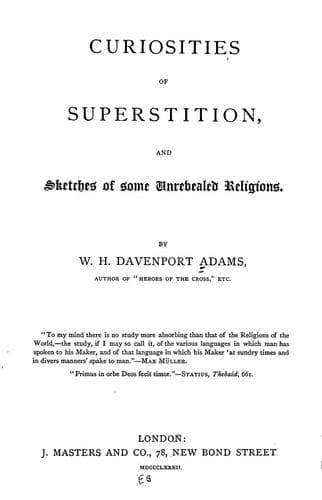
Curiosities of Superstition, and Sketches of Some Unrevealed ReligionsAdams, W. H. Davenport (William Henry Davenport)
Religion
Curiosities of Superstition, and Sketches of Some Unrevealed Religions
Adams, W. H. Davenport (William Henry Davenport)
Folklore; Religions; Superstition
The Indians regard the maize, or Indian corn, with almost superstitious
veneration,--which is not wonderful, perhaps, when its immense importance
to them is taken into consideration. They esteem it, says Schoolcraft, so
important and divine a grain, that their story-tellers invented various
tales, in which this idea is symbolised under the form of a special gift
from the Great Spirit. The Odjebwa-Algonquins, who call it Mon-da-min, or
the Spirit’s grain or berry, cherish a legend, in which the stalk in full
tassel is represented as descending from the sky, under the guise of a
handsome youth; in response to the prayers of a young man offered at his
fast of virility, or coming to manhood.
“All around the happy village
Stood the maize-fields, green and shining,
Waved the green plumes of Mondamin,
Waved his soft and sunny tresses,
Filling all the land with plenty.”
CHAPTER XVI.
_AMONG THE ESKIMOS._
The success which has attended the labours of the Lutheran and Moravian
Missionaries among the Eskimos has been well deserved by their
self-denying devotedness. Few of the Arctic tribes are now outside the
pale of Christianity; and all have been more or less directly influenced
by its elements of purification and elevation. But prior to the coming of
the pioneers of the Cross, the moral code of the Eskimo was curiously
imperfect, and did not recognise murder, infanticide, incest, and the
burial of the living among its crimes. Woe to the unfortunate vessel which
touched upon the coast! The Eskimos were not less treacherous than the
Polynesians of the Eastern Seas. And Krantz relates the story of a Dutch
brig that was seized by the natives at the port of Disco in 1740. The
whole crew were murdered. Two years later a similar fate befell the crew
of another vessel that had accidentally stranded.
The religion or creed of the aborigines seems to have been very vague and
imperfect. It is certain, however, that they believed in the immortality
of the spirit, and in a heaven and a hell. It was natural enough that
their conception of the latter should be affected by the conditions under
which they lived; that their experience of the miseries of an Arctic
climate should lead them to think of hell as a region of darkness and of
ice, traversed by endless snow-storms, and without any seals.
They placed implicit confidence in their angekoks, or angekos, or
“medicine-men,” ascribing to them almost unlimited powers over the things
of earth and sea, this world and the next. When setting out for the chase,
or prostrated by illness, they always sought the assistance of the
angekoks, who, on such occasions, indulged in a variety of strange
ceremonies. The nature of these may be inferred from what was witnessed by
Captain Lyon, who, during his famous Arctic voyage, bribed an angekok,
named Toolemak, to summon a Tomga, or familiar demon, in the cabin of his
ship.
Public-domain text, read in full here on John Shaqi.
Reviews
Reviews
No reviews yet
Be the first to share your thoughts on this work.
Elsewhere in the archive
Join the Discussion
Join the discussion
Sign in to leave a comment or review.
Sign InorCreate an account