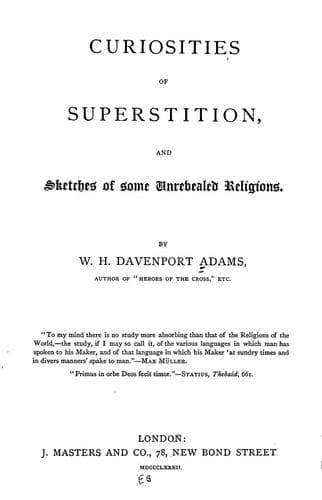
Curiosities of Superstition, and Sketches of Some Unrevealed ReligionsAdams, W. H. Davenport (William Henry Davenport)
Religion
Curiosities of Superstition, and Sketches of Some Unrevealed Religions
Adams, W. H. Davenport (William Henry Davenport)
Folklore; Religions; Superstition
“All musical instruments and love-songs ceased to be heard. The only music
that prevailed both in town and country was that of the lugubrious voice
of the penitent, whose mournful accents might have moved hearts of flint:
and even the eyes of the obdurate sinner could not refrain from tears. Nor
were women exempt from the general spirit of devotion we mention; for not
only those among the common people, but also matrons and young ladies of
noble families, would perform the same mortifications with modesty in
their own rooms.
“Then those who were at enmity with one another became again friends.
Usurers and robbers hastened to restore their ill-gotten riches to their
right owners. Others, who were contaminated with different crimes,
confessed them with humility, and renounced their vanities. Gaols were
opened; prisoners were delivered; and banished persons permitted to return
to their native habitations. So many and so great works of sanctity and
Christian charity, in short, were then performed by both men and women,
that it seemed as if an universal apprehension had seized mankind, that
the divine power was preparing either to consume them by fire, or destroy
them by shaking the earth, or some other of those means which Divine
justice knows how to employ for avenging crimes. Such a sudden repentance,
which had thus diffused itself all over Italy, and had even reached other
countries, not only the unlearned, but wise persons also admired. They
wondered whence such a vehement fervour of piety could have proceeded:
especially since such public penances and ceremonies had been unheard of
in former times, had not been approved by the sovereign pontiff, nor
recommended by any preacher or person of eminence; but had taken their
origin among simple persons, whose example both learned and unlearned
alike had followed.”
* * * * *
Public-domain text, read in full here on John Shaqi.
Reviews
Reviews
No reviews yet
Be the first to share your thoughts on this work.
Elsewhere in the archive
Join the Discussion
Join the discussion
Sign in to leave a comment or review.
Sign InorCreate an account