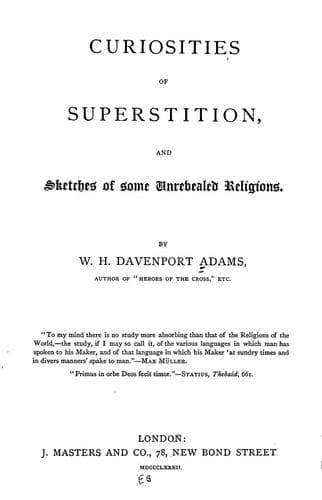
Curiosities of Superstition, and Sketches of Some Unrevealed ReligionsAdams, W. H. Davenport (William Henry Davenport)
Religion
Curiosities of Superstition, and Sketches of Some Unrevealed Religions
Adams, W. H. Davenport (William Henry Davenport)
Folklore; Religions; Superstition
The imaginative element in the character of the Celtic race naturally
predisposes them to the reception and retention of fanciful ideas in
connection with our relations to the unseen. Keenly sensible of the
existence of supernatural influences, they are morbidly curious as to the
mode in which they act upon humanity, and ever desirous to propitiate or
guard against them. There is something in the presence of the sea and the
mountains which fosters a habit of reverie; and the mind, awed and
perplexed by the vastness of the forces of Nature, is led to give them an
actual and definite embodiment, and to associate them directly with the
incidents of our mortal life. Granted the existence of invisible
creatures, there is no reason why man, who looks upon the universe as a
circle of which he is the centre, should not suppose them to be interested
in all that interests himself; and when this is once admitted, it follows
as an inevitable result, that he will endeavour to make them the agents of
his inclination or his will, unless he fears them as powers whose anger
must be reverently deprecated. It will be found that most of the popular
superstitions to which we refer are based upon these motives; that most of
them originate in the desire to bribe and cajole Fortune, or to command
and defeat it. Others will be found to have had their rise, as we have
hinted, in the feelings of awe and wonder awakened by the mystery or the
grandeur of Nature. The wail of waters against a rocky coast has suggested
the cries of the ocean maiden who seeks to lure the mariner to his
destruction; the wreathing mists floating in fantastic shapes across the
mountain valleys, has peopled their depths with a world of spirits or
friendly or inimical to mortals. The imagination, which has been quickened
by Nature, proceeds in turn to breathe into Nature a new life.
To some of the superstitions which haunt the glens, and peaks, and
torrents of the Scottish Highlands, the poet Collins has alluded in one of
his most beautiful odes. He speaks of the North as fancy’s land, where
still, it is said, the fairy people meet, beneath the shade of the
graceful birches, upon mead or hill. To the belief in a tribe of
hobgoblins, tiny creatures, visiting the peasant’s hut in the silence of
the night, he also refers:--
“There, each trim lass, that skims the milky store,
To the swart tribes their creamy bowls allots;
By night they sip it round the cottage door,
While airy minstrels warble jocund notes.”
The malicious disposition of the elves is thus insisted upon:--
“There every herd, by sad experience, knows
How, wing’d with fate, their elf-shot arrows fly,
When the sick ewe her summer food foregoes,
Or, stretch’d on earth, the heart-smit heifers lie.”
To superstitions of higher import the poet alludes in the following noble
lines:--
Public-domain text, read in full here on John Shaqi.
Reviews
Reviews
No reviews yet
Be the first to share your thoughts on this work.
Elsewhere in the archive
Join the Discussion
Join the discussion
Sign in to leave a comment or review.
Sign InorCreate an account