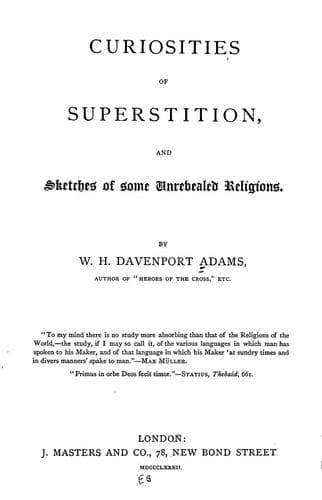
Curiosities of Superstition, and Sketches of Some Unrevealed ReligionsAdams, W. H. Davenport (William Henry Davenport)
Religion
Curiosities of Superstition, and Sketches of Some Unrevealed Religions
Adams, W. H. Davenport (William Henry Davenport)
Folklore; Religions; Superstition
A survival of the old Paganism is, undoubtedly, this apprehension of
ill-luck connected with the giving or stealing of fire; and it recalls to
us the days when every mountain-peak was as an altar raised to Baal, and
Sun and Moon were worshipped with solemn mysterious rites. On the great
Fire-festival the priests kindled fire by friction, and the people carried
it to their cottages, where it was kept alive all round the year and
extinguished only when a new supply was ready. “As the purchase of the
fire was a source of profit to the priests, it would naturally be
considered criminal for one neighbour to give it to another at the seasons
when every man was bound to purchase it for himself. Of course, though the
old customs are still retained, their original meaning is utterly
forgotten; and the man who throws a live peat after a woman who is about
to increase the population, or he who on Halloween throws a lighted brand
over his own shoulder without looking at whom he aims, little dreams
whence sprang these time-honoured games.” It is said that in many parts of
the remote glens of Perthshire there are women still living who on Beltane
morn always throw ashes and a live peat over their heads, repeating a
certain formula of words to bring them back. But the strictest secrecy is
observed, lest such practices should reach the ear of “the minister:” so
the stronger their belief, the less willing are they to confess to any
knowledge of such matters.
We cannot pass from this subject without an allusion to the Fire-Churn or
Need-Fire, which is held a sovereign charm against cattle-plague. When in
a Highland district an invasion of murrain was apprehended, a small shanty
or hut was erected near loch or river, and in it were placed various
wooden posts, vertical and horizontal: the horizontal were provided with
several spokes, and being rapidly turned round against the upright,
quickly generated a flame by the friction. Then all other fires upon the
farm were extinguished, to be re-lighted from the Need-fire, which all the
cattle were afterwards made to smell, until the charm was complete.
* * * * *
It was on Halloween, or All Hallows’ Eve--the evening of the 31st of
October--that Superstition ran riot, because on that particular evening
the supernatural influences of the other world were supposed to be
specially prevalent, and the power of divination was likewise believed to
be at its height. Spirits then walked about with unusual freedom, and
readily responded to the call of those armed with due authority. In the
prehistoric past, the Druids at this time celebrated their great autumn
Fire-Festival, insisting that all fires, except their own, should be
extinguished, so as to compel men to purchase the sacred fire at a certain
price. This sacred fire was fed with the peeled wood of a certain tree,
and that it might not be polluted, was never blown with human breath.
Public-domain text, read in full here on John Shaqi.
Reviews
Reviews
No reviews yet
Be the first to share your thoughts on this work.
Elsewhere in the archive
Join the Discussion
Join the discussion
Sign in to leave a comment or review.
Sign InorCreate an account