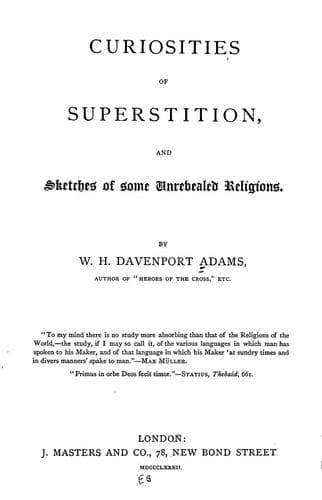
Curiosities of Superstition, and Sketches of Some Unrevealed ReligionsAdams, W. H. Davenport (William Henry Davenport)
Religion
Curiosities of Superstition, and Sketches of Some Unrevealed Religions
Adams, W. H. Davenport (William Henry Davenport)
Folklore; Religions; Superstition
Following up the course of human life through the honeyed days of “wooing
and wedding,” we find it darkened still by the clouds of Superstition. If
a maiden desired to call up the image of her future husband, she read the
third verse, seventeenth chapter of the Book of Job after supper, washed
the supper dishes, and retired to bed without uttering a single word,
placing before her pillow the Bible, with a pin thrust through the verse
she had read. It is curious to observe the use of the Bible in these wild
and foolish customs: was it not an indirect testimony to the reverence,
not always intelligent, perhaps, but certainly sincere, in which the holy
book was held? Nor are we certain that it is not sometimes turned to worse
purposes in these “enlightened days,” when a pseudo-science seeks to
convert it into the battle-field of audacious theories, and an ignorant
intolerance too often professes to discover in its bright and blessed
pages an excuse for its uncharitable follies.
But we must continue our _resumé_. It is curious to read that the
wedding-dress might not be “tried on” before the wedding-day, and if it
did not fit, it might not be cut or altered, but was adjusted in the best
manner possible. The bride, on the way to church, was forbidden to look
back, for to do so was to ensure a succession of disasters and quarrels in
the married state. It was considered inauspicious, moreover, if she did
not “greet” or weep on the marriage-day; a superstition obviously
connected with the wide-spread idea of the necessity of propitiating the
Fates which inspired the advice of Amasis to the too fortunate
Polycrates,[66] that he should fine himself for his success by throwing
some costly thing into the sea. It was thought well to marry at the time
of the growing moon, and among fisher-folk a flowing tide was regarded as
“lucky.” These customs were puerile enough, undoubtedly, but before we
censure them too severely we may ask whether our modern bridals are wholly
free from superstitious observances; whether we do not still pretend to
“bribe” the fickle Fortune by showers of rice and old slippers rained on
the departing couple!
Public-domain text, read in full here on John Shaqi.
Reviews
Reviews
No reviews yet
Be the first to share your thoughts on this work.
Elsewhere in the archive
Join the Discussion
Join the discussion
Sign in to leave a comment or review.
Sign InorCreate an account